
Terebess
Asia Online (TAO)
Home
Zen Index
.
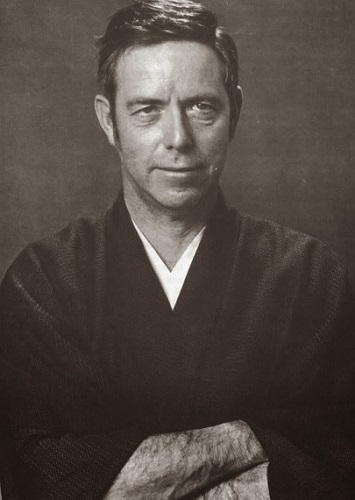
Alan Watts (1915-1973)
Alan
Watts
Self and Other
a lecture
Now, the subject of this seminar is 'Self and Other,' and this is therefore to be an exploration into the subject that interests me most, which is the problem of personal identity, man's relationship to the universe, and all the things that are connected with that. It is, for our culture at this time in history an extremely urgent problem, because of our technological power. In known history, nobody has had such capacity for altering the universe than the people of the United States of America. And nobody has gone about it in such an aggressive way.
I think sometimes that the two symbols of our present kind of technological culture are the rocket ship and the bulldozer. The rocket as a very, very phallic symbol of compensation for the sexually inadequate male. And the bulldozer, which ruthlessly pushes down hills and forests and alters the shape of the landscape. These are two symbols of the negative aspect of our technology. I'm not going to take the position that technology is a mistake. I think that there could be a new kind of technology, using a new attitude. But the trouble is that a great deal of our power is wielded by men who I would call 'two o'clock types.'
Maybe you saw an article I wrote in "Playboy" magazine called "The Circle of Sex," and it suggested at least a dozen sexual types rather than two. And that the men who are two o'clock on the dial, like a clock, are men who are ambisexterous, named after Julius Caesar, because Julius Caesar was an ambisexterous man, and he equally made love to all his friend's wives and to his good-looking officers. And he had no sense of guilt about this at all. Now, that type of male in this culture has a terrible sense of guilt, that he might be homosexual, and is scared to death of being one, and therefore he has to overcompensate for his masculinity. And so he comes on as a police officer, Marine sergeant, bouncer, bookie, general--tough, cigar-chewing, real masculine type who is never able to form a relationship with a woman; they're just 'dames' as far as he's concerned. But he, just like an ace Air Force pilot puts a little mark on his plane each time he shoots down an enemy, so this kind of man, every time he makes a dame he chalks up one, because that reassures him that he is after all a male. And he's a terrible nuisance. The trouble is that the culture doesn't permit him to recognize and accept his ambisexterity. And so he's a trouble spot.
But that kind of spirit of knocking the world around is something that is causing serious danger here. It arises, you see, because this tremendous technological power has been evolved in a culture which inherits a sense of personality which is frankly a hallucination. And we get this sense of personality from a long, long tradition of Jewish and Christian and Greek ideas which have caused man to feel that the universe of nature - the physical world, in other words - is not himself. You may think that that is a very odd thing to say, because one always assumes that oneself is one's own body, or at least something inside one's body, like a soul. And that naturally, everything outside is not oneself. But this is, as I've said many, many times, a hallucination. Let's think, here we are in the middle of New York City. And you know what happens when New York City goes wrong. When there's a subway strike, or when the power fails, or when the sewers back up, your life is in danger. Because you are not only constituted by the bloodstream of your veins and the communications network of your nervous system. An extension of your bloodstream, and of your alimentary canal, and of your nervous system, is all the communication systems of this city.
In other words, you know well every night streams of trucks pour into this city, carrying food. I understand there is even a kind of big drain pipe which brings milk in. You consume three million pounds of fish a week. You then also have to have the exit end of this. The sewers are very complicated. The water system and all it's pipes, the telephone systems, the electric light systems, the air conditioning things, the traffic streams. All these things going on are essential extensions of your own inner tubing. And therefore, you have to be aware, more and more, that the city is an extended body for every person living in it. And not only of course the city, because the city depends on untold acres of fields where farm products are grown, cattle are raised, on lakes and underground water sources; on the constitution of the atmosphere, and finally on the location of the Earth on this propitious spot rather close to the sun, where we have our basic heating system working.
And all that is not a world into which you arrived, from somewhere else altogether. It is a complex system of relationships, out of which you grew in exactly the same way that fruit grows on a tree, or a flower on a stem. Just as these blossoms here are symptomatic of the plant, and you identify the plant by looking at the blossoms - here are these little oranges, you see - we know that this is an orange tree. Now in exactly that way, you are all growing in this world, and so we know that this world is a 'humaning' system - and therefore it has a certain kind of innate intelligence, just as this tree, with its roots, has the innate intelligence which comes out in these oranges.
So the cosmos in which we live is a network of communications. You don't need to think of it in an authoritarian pattern, namely there is God the father, who makes it all work, because that doesn't really answer anything. That's just applying to the world an explanation derived from the political systems of the ancient Near East. You realize that? The great political systems of the Egyptians and the Chaldeans, where there was an enormous father figure in charge of everything, became the model for the idea of monotheism. And these great kings, like Hammurabi and Amenhotep IV, laid down legal systems so man thought of a prince, a king of kings, a lord of lords, in the words of the Book of Common Prayer. It's a political idea. And I often wonder how citizens of a republic, who have to curse and swear that they think that this is the best form of government, can put up with a monarchial conception of nature. Very funny. You know, a republic, and it says 'In God We Trust,' and most people by God mean a king of the universe. Very strange.
But you don't have to think that way in order to have the faith that the universe is something other than mere stupid, blind energy. What we are coming to see is that the total universe, consisting of all its galaxies, and not only this galaxy, is a living organism. How will we define that? What do we mean by a living organism? I mean a system of intercommunication of extreme complexity. Just like you are. You try to define what you are, and you go into it, you suddenly discover that as you take off the skin and look underneath, that we are an enormously complex system of tubes and fibers, beautifully patterned. When we look at it with a microscope, we say 'Oh my, look at that. Isn't that gorgeous?' Have you seen those models of cells that the Upjohn Company has made? They're exquisite. And incidentally, you should all, if you've never done so, go to the Charles Darwin Hall in the New York Museum of Natural History and see the glass models of the tiniest microorganisms, called radiolaria. They are also such things as are running around in you, and they are incomparable jewelry.
Now I suppose if we looked at ourselves from that microscopic point of view, all these funny creatures that are running around us that don't look like people, would if you got used to them seem like people. And they would be having their problems. They've got all sorts of fights going on, and collaborations and conspiracies and so on. But if they weren't doing that, we wouldn't be healthy. If the various corpuscles and cells in our blood stream weren't fighting each other, we would drop dead. And that's a sobering thought, that war at one level of being can bring peace and health at another.
So we are, inside us, each individial body, an enormous ecological system. And what we have to recognize is that that interconnected system which constitutes the beauty of a human organism, that sort of interconnection is going on outside us. Do you remember in early science fiction that was published in the 1920s, by people like Olaf Stapleton and some of the early writers? They pictured the men of the future as having huge heads to contain very big brains. It was expected, in other words, that the future evolution of mankind would be an evolution of the mind and the brain, and so bigger brains. But what has happened instead of that is that instead of evolving bigness of brain, we are evolving an electronic network in which our brains are very swiftly being plugged into computer systems. Now some very awkward things about this are arising, and we've got to watch out for it, because what has increasingly happened is this: nobody is having any private life left. The invasion of ordinary privacy by the telephone, by your watching television, which is after all looking at somebody else's life going on, by people watching you - all the people with bugging systems and snoopers, and credit agents, and everybody knows everything about you. Even in California, all the houses are built with picture windows looking at other picture windows, and if you draw the curtains, everyone thinks you're snooty. Like if you build a fence in most Midwestern communities, they think 'Who the hell do you think you are, building a fence to keep everybody else out? See, you're not democratic.'
But the reason for all this is, imagine the situation when all the original neurons became linked in with the central nervous system. They said, 'Well, we're losing our privacy.' So it's a very serious question as to how we're going to be linked in with other people. I feel - it may be old fashioned of me - but I feel very strongly that privacy should be maintained as much as possible. But the reason being that human beings, in my experience, are a combination of two worlds - the private world and the public world - such that a person with a very strong and different and unique personality is not an isolated person, but a person extremely aware of his identity with the rest of the universe. Whereas people with nondescript, mass-produced personalities tend to be unaware of this. They tend to be the kind of person who is taken in by the system.
So what I think we could aim for in the way of human civilization and culture would be a system in which we are all highly aware of our existing interconnection and unity with the whole domain of nature, and therefore do not have to go to all sorts of wild extremes to find that union. In other words, look at the number of people we know who are terrified of silence, and who have to have something going all the time, some noise streaming into their ears. They're doing that because of their intense sense of loneliness. And so when they feel silent, they feel lonely and they want to escape from it. Or people who just want to get together. As we say, they want to escape from themselves. More people spend more time running away from themselves. Isn't that wretched? What a definition. What an experience of self if it's something you've always got to be running away from and forgetting. Say you read a mystery story. Why? So you forget yourself. You join a religion. Why? To forget yourself. You get absorbed in a political movement. Why? To forget yourself. Well it must be a pretty miserable kind of self if you have to forget it like that. Now for a person who doesn't have an isolated sense of self, he has no need to run away from it, because he knows.
Let's take hermits. People today think being a hermit is a very unhealthy thing to do. Very antisocial, doesn't contribute anything to everybody else - because everybody else is busy contributing like blazes, and a few people have to run off and get out of the way. But I'll tell you what hermits realize. If you go off into a far, far forest and get very quiet, you'll come to understand that you're connected with everything. That every little insect that comes buzzing around you is a messenger, and that little insect is connected with human beings everywhere else. You can hear. You become incredibly sensitive in your ears and you hear far-off sounds. And just by the very nature of isolating yourself and becoming quiet, you become intensely aware of your relationship with everything else that's going on. So if you really want to find out how related you really are, try a little solitude off somewhere, and let it begin to tell you how everything is interdependant in the form of what the Japanese buddhists call 'jijimugi'(?). 'Ji' means a 'thing event,' so it means 'between thing event and thing event, there is no block.' Every thing in the world, every event, is like a dewdrop on a multidimensional spider's web, and every dewdrop contains the reflection of all the other dewdrops. But you see, the hermit finds this out through his solitude, and so also human beings can acquire a certain solitude, even in the middle of New York City. It's rather easier, as a matter of fact, to find solitude in New York City than it is in Des Moines, Iowa.
But the point is that a human represents a certain kind of development, wherein a maximal sense of his oneness with the whole universe goes hand in hand with the maximum development of his personality as somebody unique and different. Whereas the people who are of course trying to develop their personality directly and taking a Dale Carnegie course on how to win friends and influence people, or how to become successful - all those people come out as if they came from the same cookie cutter. They don't have any personality.
Now then, it therefore becomes the great enterprise of our time from this point of view so this technology shall not go awry, and that it shall not be a war with the cosmos, that we acquire a new sense of identity. It isn't just a theoretical thing that we know about, as ecologists, for example, know about the identity of the organism with its environment, but becomes something that we actually experience. And I feel that this is not at all beyond the bounds of possibility for an enormous number of people. For a simple reason. Let me draw a historical analogy. Several hundred years ago, it seemed absolutely incomprehensible for most people that the world could be round, or that the planets and stars should be up in the sky unsupported, or even that the Earth itself should be floating freely in space. The Earth is falling through space, but it seems stable, and therefore it was supposed in ancient mythologies that the Earth rested on a giant turtle. Nobody asked too carefully what the turtle rested on, but just so that there was some sense of solidity under things. So in the same way that the stars were supposed to be suspended in crystal spheres, and just as people know that the Earth is flat because you can look at it and see that it is, so people looked into the sky and they could see the crystal spheres. Of course you could see the crystal spheres: you could see right through them. So when the astronomers cast doubts on the existence of crystal spheres, everybody felt threatened, that the stars were going to fall on their heads. Just as when they talked about a round Earth, people felt a danger of if you went around to the other side, you'd drop off, or feel funny and upside-down, a rush of brains to the head, and all sorts of uncomfortable feelings. But then since then, we have got quite used to the idea that the stars float freely in space in gravitational fields, that you can go around the Earth without falling off, and now everybody realizes this and feels comfortable with it.
Likewise, in our day when Einstein propounded the theories of relativity, people said they couldn't understand it. It used to be something at a cocktail party to be introduced to somebody who understands Einstein. Now every young person understands Einstein and knows what it's about. You've got even one year of college, you know what relativity is. And you know it not only in an intellectual way, you know this as a feeling, just as you have a feeling of the roundness of the world, especially if you travel a lot on jet planes. So I feel that in just that way, within I don't know how many years, but in not too long a time, it's going to become basic common sense that you are not some alien being who confronts an external world that is not you, but that almost every intelligent person will have the feeling of being an activity of the entire universe.
You see, the point is that an enormous number of things are going on inside us of which we are not conscious. We make a very, very arbitrary distinction between what we do voluntarity and what we do involuntarity, and we define all those things which we do involuntarily as things which 'happen' to us, rather than things that we do. In other words, we don't assume any responsibility for the fact that our heart beats, or that our bones have such and such a shape. You can say to a beautiful girl, 'Gee, you're gorgeous,' and she'd say 'How like a man, all you think about is bodies. My body was given to me by my parents, and I'm not responsible for it, and I'd like to be admired for my self and not for my chassis.' And so I'd tell her 'You poor little chauffeur. You've disowned your own being and identified yourself not being associated with your own body.' I agree that if she had a terrible body with a lousy figure, she might want to feel that way, but if she is a fine-looking human being, she should get with it and not disown herself. But this happens again and again.
So you see, if you become aware of the fact that you are all of your own body, and that the beating of your heart is not just something that happens to you, but something you're doing, then you become aware also in the same moment and at the same time that you're not only beating your heart, but that you are shining the sun. Why? Because the process of your bodily existence and its rhythms is a process, an energy system which is continuous with the shining of the sun, just like the East River, here, is a continuous energy system, and all the waves in it are activities of the whole East River, and that's continuous with the Atlantic Ocean, and that's all one energy system and finally the Atlantic ocean gets around to being the Pacific Ocean and the Indian Ocean, etc., and so all the waters of the Earth are a continuous energy system. It isn't just that the East River is part of it. You can't draw any line and say 'Look, this is where the East River ends and the rest of it begins,' as if you can in the parts of an automobile, where you can say 'This is definitely part of the generator, here, and over here is a spark plug.' There's not that kind of isolation between the elements of nature.
So your body knows that its energy system is one with and continuous with the whole energy system, and that if it's in any sense true to say that I am my body, and that I beat my heart, and that I think by growing a brain, where do you draw the line between what you think and the power to think? Do you think with your brain in the same way that you carve wood with a knife? Y'know, it's an instrument that you pick up and use. I don't think our bodies are just instrumental in that way. They're something we are doing, only we don't think about it, in the sense that we don't have to consider when we get up in the morning as an act of voluntary behavior how to connect all of the switches in our brain to get us ready for the day; they come on automatically. But this automatic or, I would rather call it, spontaneous functioning of the brain is what is called in Japanese 'shizen'(?), that is to say, the spontaneity of nature. It does all this, and what we perform consciously is simply a small fragment of our total activity, of which we happen to be aware in a special way. We are far more than that. And it isn't only, say, that the sun is light because we have eyes and optical nerves which translate the energy of the sun into an experience called 'light.' It is also that that very central fire of the sun is something that you are doing just as much as you are generating temperature in your body.
In other words, let's suppose that those cosmologists and astronomers are right who believe that this universe started out with an original big bang, which flung all those galaxies out into space. Well, you know what that would be like. It'd be like taking a bottle of ink and flinging it hard at a white wall, and it makes a great splash. And you know how the nature of a splash is--in the middle of it, it's dense, and as it gets to the outside of the splash, there's all kinds of curlicues. But it's a continuous energy system. In other words, the bang in the beginning cannot really be separated from the little curlicues at the end. So, supposing there was an original cosmic explosion which went FOOM, we sitting around in this room now are little curlicues on the end of it, you see? We are, actually, every one of us is incredibly ancient. The energy which is now manifested as your body is the same energy which was there in the beginning. If anything at all is old, this hand is as old as anything there is. Incredibly ancient. I mean, the energy keeps changing shapes, doing all sorts of things, but there it all is. It's one continuous SPAT.
Now, if you just want to define yourself as a little curlicue on the end of things and say 'That's all of me there is,' then you've got to be a puppet and say 'Well, I've been pushed around by this whole system.' Like a juvenile delinquent who knows a little Freud. 'Well I can't help what I'm doing, because it was my mother. She was terribly mixed up, and she didn't bring me up properly, and my father was a mess. He was an alcoholic and he never paid any attention to me. So I'm a juvenile delinquent.' So the social worker says 'Yes, I'm afraid that's so,' and eventually some journalist gets a hold of it and says 'We should punish the parents instead of the kids.' So they go around to the parents and the mother says 'Yes, I admit I'm a mess,' and the father says 'Of course I'm an alcoholic, but it was OUR parents who brought us up wrong, and we had all that trouble.' Well, they can't find them because they're dead. And so you can go passing the buck way back, and you get to some characters called Adam and Eve. And when THEY were told they were responsible, they passed it again to a snake. And when that snake was asked about it, he passed the buck back to God, and God said 'I disown you, because I don't let my right hand know what my left hand doeth.' And you know who the left hand of God is. The right hand is Jesus Christ, the left is the Devil. Only it mustn't be admitted. Not on your life.
But that's the whole thing, you see, in a nutshell. That once you define yourself as the puppet, you say 'I'm just poor little me, and I got mixed up in this world. I didn't ask to be born. My father and mother gave me a body which is a system of tubes into which I got somehow mixed up, and it's a maze and a tunnel and I don't understand a way around it. It needs all these engineers and doctors and so on to fix it, educate it, tell it how to keep going, and I'm mixed up in it. Poor little me.' Well this is nonsense! You aren't mixed up in it, it's you, and everybody's being a blushing violet and saying 'I'm not responsible for this universe, I merely came into it.' And the whole function of every great guru is to kid you out of that, and look at you and say 'Don't give me that line of bull.' But you have to be tactful; you have to be effective. You can't just tell people this. You can't talk people out of an illusion. It's a curious thing.
There's a whole debate going on now, as you all know, about whether God exists, and they're going to do a cover story on God in 'Time' magazine, and they sent a reporter around to me - they sent reporters around to all sorts of prominent theologians and philosophers. I said 'I have a photograph of God which you must put on the cover.' It's a gorgeous photograph of a Mexican statue made by Dick Borst(?). Beautiful God-the-father with a crown like the Pope. Only they said they were going to use something by Tintoretto. This photograph is a lovely thing. You know, a real genuine Mexican Indian thing. Simple people think this is what God looks like; very handsome man. Anyway, they're going to do a cover story on God because the theologians are now arguing about a new kind of Christianity which says there's no God and Jesus Christ is his only son. But what these people want to do is they desperately want to keep the church in Christianity because it pays off, that's the minister's job, and although they feel very embarrassed about God, what they're doing is they want the Bible and Jesus to sort of keep this authority going. How you can do that, I don't know.
But at any rate, the point is that God is what nobody admits to being, and everybody really is. You don't look out there for God, something in the sky, you look in you. In other words, underneath the surface of the consciousness that you have and the individual role that you play and are identifying yourself with, you are the works. Just as you ARE beating your heart, in the same way you're shining the sun, and you're responsible. But in our culture, you mayn't admit this, because if you come on that you're God, they'll put you in the nuthouse. Because our idea of God is based on Near Eastern politics, and so if you're God, then you're the ruler, the governor - 'Oh Lord our governor!' And so if you're the governor, you know all the answers if that's what you claim to be. So when anybody in our culture says 'I'm God,' we say 'Well, well, why don't you turn this shoe into a rabbit and show me that you're God.'
But of course in Oriental cultures, they don't think of God as an autocrat. God is the fundamental energy of the world which performs all this world without having to think about it. Just in the same way that you open and close your hand without being able to say in words how you do it. You do it. You say 'I can open and close my hand.' But how? You don't know. That only means, though, that you don't know in words. You do know in fact, because you do it. So in the same way, you know how to beat your heart, because you do it, but you can't explain it in words. You know how to shine the sun, because you do it, but you can't explain it in words, unless you're a very fancy physicist, and he's just finding out - what a physicist is doing is translating what he's been doing all along into a code called mathematics. Then he says he knows how it's done. He means he can put it into the code - and that's what the academic world is. It's translating what happened into certain codes called words, numbers, algorythms, etc., and that helps us repair things when they go wrong.
So, the discovery of our inseparability from everything else is something that I don't think will have to come by the primitive methods of difficult yoga meditations, or even through the use of psychedelic chemicals. I think it's something that's within the reach of very many people's simple comprehension. Once you get the point. Just in the same way you can understand that the world is round and you experience it as such. You could call this a kind of guinana(?) yoga, in Hindu terms. But I don't think it's going to be necessary for our culture to get this point by staring at it's navel, or by spending hours practicing Za-Zen, not that I've got anything against it, because after all, to sit still can be an extraordinarily pleasant thing to do, and it's important for us to have more quiet. But I think this is essentially a matter of intuitive comprehension that will dawn upon us and suddenly hit us all in a heap, and you suddenly see that this is totally common sense, and that your present feeling of how you are is a hoax. You know how Henry Emerson Foster wrote a book called 'How to be a Real Person'? Translated into it's original terms, that means 'How to be a Genuine Fake.' Because the person is the mask, the 'persona' worn by actors in Greco-Roman drama. They put a mask on their face which had a megaphone-shaped mouth which projected the sound in an open- air theater. So the 'dramatis persona' at the beginning of a play is the list of masks, and the word 'person,' which means 'mask,' has come to mean the real you. 'How to be a Real Person.' Imagine.
But I think we'll get over it, and discover the thing that we simply don't let our children in on, that we don't let ourselves in on. Let me emphasize this point again. It is not at the moment common sense, not plausible, because of our condition, but we can very simply come to see that YOU are not some kind of accident that pops up for a while and then vanishes - but that deep inwards, you are what there is and all that there is, which is eternal, and that which there is no whicher. That's you. Now, you don't have to remember that all the time, as you don't have to remember how to beat your heart. You could die and forget everything you ever knew in this lifetime, because it's not necessary to remember it. You're going to pop up as somebody else later on, just as you did before, without knowing who you were. It's as simple as that. You were born once, you can get born again. If there was a cosmic explosion once that blew everything into existence and is going to fizzle out, if it happened once, it can happen again, and it goes on..
It's a kind of undulating system of vibrations. Everything's a system of vibrations. Everything is on/off. Now you see it, now you don't. Light itself is, but it's happening so fast that the retina doesn't register it. Everything in the sun is like an arc-lamp, only it's a very fast one. It goes on-off. Sound does; and the reason you can't put your finger through the floor is the same reason you can't, without serious problems, push it through an electric fan. The floor is going so fast. Even faster than a fan. The fan is going slow enough to cut your finger if you put it into it. But the floor is going so fast, you can't even get in. But that's the only reason. It's coming into existence and going out of existence at a terrific clip. So everything is on/off. So is our life. You can die, say 'Well, I don't know where I'm going, I don't know anything.' Just like in the same way you don't know what's going on inside your nervous system. How the nervous system links together, or anything like that. You don't need to know, and if you had to find it all out, you'd get so confused with all the information that you wouldn't be able to operate. It'd be just too much to think about with a single-pointed ordinary attention consciousness, which is a scanning system, like radar. You don't need to know how it all works in order to work it out. That's the real meaning of omnipotence.
ALAN WATTS: SELF AND OTHER, part 2 of 3
This morning, I was discussing the problem of technological civilization's urgent need for a new sense of human existence, in which the human being no longer discovers himself as an alien oddity, somehow trapped and caught up in a system of tubes called the body, confronting an external world which is not himself. The urgency of realizing that just as this city is an extension of you, so is everything out to the farthest galaxies that we have any knowledge of, and beyond. Of regaining a sense of responsibility and identity with the basic functioning of your self as a complete physical organism, and that beyond that, your own organism, in a certain sense, knows its identity with its whole environment. In other words, the human body belongs in a continuous energy system which is co-extensive with the universe. And instead of making out that this is something you got caught up in, and for which you are not responsible, and in which you are just a victim, and if you're lucky, you beat the game for a while, and win until death destroys you and you lose everything. You know, you can't take it with you.
That reminds me of a funny-- Gary Schneider is a great friend of mine. He's a poet from the West Coast, and he's a very good Zen student. He's studying under Oda-Roshi. And he suggested one day that we found a null and void title in Gary and Trust Company, with its slogan 'Register your absence with us.' And what you do is, you give your fortune to us, and we guarantee to transport it to you in the next life.
Anyway. This situation, I was suggesting, is one that can be overcome reasonably simply, if you can just get the idea straight. A lot of people say, you know, 'I understand what you say intellectually, but that's not enough. I don't really understand it.' But I often think that when people say that, they don't fully understand it intellectually. If you can get something quite clear, really clear in your head, I don't think that our mind is compartmentalized so that the intellect's over here, and the feelings are over here, and the intuition is over there, and the sensations are over there. I don't think Jung meant that when he made that classification. I think every faculty of the mind is continuous with all the others.
And so what you're saying when you say 'I understand it intellectually, but I don't get it intuitively,' or 'I don't feel it in my bones,' is that you understand it in the sense of being able to repeat a form of words. Now it's true that there's lots of debates and problems that are purely verbal. A great deal of what goes on as theological or philosophical discussion is absolutely nothing except a war of words. A logical positivist, for example, can show conclusively that all metaphysical statements are meaningless. But so what? That's just talk. People have, on the other hand, experienced, say, mystical states, and these experiences are quite as real as the experience of swimming in water, or lying in the sun, or eating a steak, or dying. And you can't talk them away. They're THERE, in a very concrete sense. But there is a very close connection between your conceptual understanding of the world and how you actually see the world.
In other words, let's take for example this problem: there are people who don't have number systems going beyond three. They count 'One, two, three, many.' So anything above three is a heap, or many. Now those people cannot know that a square table has four corners. It has many corners. But once you're able to count beyond four, you can extend your counting system indefinitely. You have a different feeling about nature. It's not only you know more, but you feel more. You feel more clearly. So my point is simply that the intellect is not something cut off from every other kind of experience, existing in a kind of abstract vacuum which has nothing to do with anything else. The intellect is part and parcel of the whole fabric of life. It goes along with your fingers; it goes along with being able to touch. After all, what an intellectual thing in a way the human hand is. It can do things that other hands can't do. No other mammal can have thumb-finger contact. The monkey doesn't achieve it.
So the hand is intellectual. So, as a matter of fact, a plant is intellectual. This thing is a gorgeous pattern. If you look into it and realize how this is designed to absorb light and moisture and so on, and to expose itself in different ways and to propagate its species, that it's in alliance with bees and other insects, so that the bees and the plants, since they go together and are found together, they're all one continuous form of life. This doesn't exist except in a world where bees are floating around. I mean, you can bring it into an apartment, but you can't expect it to propagate beyond that point. It's decorative here. But in it's natural habitat, this goes along with being bees, and bees go with their being something else. So this form that you see here is inseparable from all kinds of other forms which must exist if this is to exist. And the bees have language, if you've read Van Fritche's(?) book about bees and their marvelous intelligence. But you see that the intelligence of the plant is the same as the pattern of the plant. You shouldn't think that I would say the plant is the result of intelligence. The shape of it is the same as its intelligence. The shape of your brain, the shape of your face, the whole structure of the culture you live in, the human interrelationships that go on-- it's that pattern which is intelligence.
Now what I'm trying to talk about is a deeper understanding of the pattern in which we live, and if you understand that, it suddenly hits you so that you feel, right in your guts, this new kind of existence that is NOT yourself alone facing an alien world, but yourself as an expression of the world in the same way as the wave is the expression of the ocean.
Now then, the most important shift one has to make in intelligence and understanding this is to be able to think in a polar way. We sometimes say of things that we want to describe as being opposed to each other as being in conflict, that they are 'the poles apart.' People who belong to different schools of thought; people who belong to nations in opposition with each other; people who are in flat, outright conflict, we say they are the poles apart. But that's a very funny phrase. Because things that are the poles apart happen to be very deeply connected. The North and the South Pole are the poles of one Earth. So try to imagine a situation in which there is an encounter between opposites, which have no connection with each other at all. Where will they come from? How will they meet each other? You think from the opposite ends of space? But what is space? For space to have opposite ends, there has to be a continuum between the ends. And so to think in a polar way is to realize the intimate connection between processes or events or things, which language describes as if they were unconnected and opposed.
Let's take, first of all, two very fundamental poles. We'll call them respectively 'solid' and 'space,' if you want existence and non-existence, because we tend to treat space as something that is not there. That's simply because we don't see it; we ignore it. We treat it as if it had no effective function whatsoever, and thus when our astronomers begin to talk about curved space, expanding space, properties of space, and so on, we think 'What are they talking about? How can space have a shape? How can there be a structure in space, because space is nothing.' But it isn't so. You see, this is something we completely ignore. Why? Because we have specialized in a form of attention to the world which concentrates on certain features as important. We call this conscious attention, and therefore it ignores or screens out everything which doesn't fit into its particular scheme. And one of the things that doesn't fit into our scheme is space. So we come into a room like this and notice all the people in the room, and the furniture, and the flowers and the ornaments, and think that everything else just isn't there. I mean, what about this interval that is between me sitting here and the inner circle of people who are arranged around the floor? What a mess we would be in if there wasn't that interval. You know, I would be blowing down your throat to talk to you.
Now intervals of this spacial kind are tremendously important. Let me demonstrate this to you in a musical way. When you listen to a melody, what is the difference between hearing that melody and hearing a series of noises? The answer is that you heard the intervals. You heard the musical spaces between the series of tones. If you didn't hear that, you heard no melody, and you would be what's called tone-deaf. But what you actually hear is the steps between the levels of sound--the levels of vibration--that constitute the different tones. Now those weren't stated, they were tacit. Only the tones were stated, but you heard the interval. So it made all the difference whether you heard the interval or not. So in exactly the same way, the intervals between us, seated around here, constitute many important things. They constitute the dignity of us all. They constitute the fact my face isn't all mushed up in your face, and that we therefore have individual faces, and that need spaces around us.
In a country like Japan, space is the most valuable commodity, because it's a small island that's heavily overpopulated. So an apartment in Japan costs you a lot of money; in Hong Kong, it's sky- high. But they have mastered the control of space in a fantastic way. And one of the ways they control space is through politeness. You can live with other people so that you live in a house where you're so close together that you can hear every belly rumble of your neighbor, and you know exactly what's going on. But you learn to hear without listening, and to see without looking. There's a courtesy, you see, a respect for privacy which puts an interval between one individual and another. And it's by reason of that interval that you are defined as you and I'm defined as I.
So you see the various kinds of space, various kinds of intervals? The pauses, when a person plays the drum--it's those intervals--otherwise it would be of no interest. It's the intervals that make the thing valuable. The space, then, is as real as the solid. This is the principle of polarity. Space and solid, in other words, which are formally opposed things. And you think, 'Well, where there is a solid, there is something, and where there is space, there is nothing.' They are actually as mutually supportive as back and front. They go together. Nobody ever found a space without a solid, and nobody ever found a solid without a space. But we've been trained to fix our attention on the solid and disregard the space. Well then obviously you haven't been given the news, you haven't been let in on what the secret of life is. It is that the space is as important as the solid. And if you see that, then you have the clue.
Now in the same way exactly, all other kinds of supposedly opposed entities and forces imply and involve each other. And this is the key to getting a different kind of consciousness of oneself, because you wouldn't know who you are unless you knew what you have defined as other than yourself. Self and other define each other mutually. Let's consider this first of all in a kind of a funny social way. In every town in the United States, there are a group of people who consider themselves to be the 'nice' people. They live on the right side of the tracks. Where I live in Sausalito, California, they live up on the hill, and down on the waterfront, there live all kinds of beatniks and bums, and we live in boats and shacks of all kinds. Some of these shacks are elegant inside, but that's a secret. We call the boat I live on the Oyster, because you know how an oyster's shell on the outside is very rough and crude, but there's pearls on the inside.
But anyway, the people up on the hill say--what do they talk about? When they get together for cocktails or dinner or whatever and they have their social occasions, what's the topic of conversation? It's how the people are awful down below, and they're encroaching and the town is going to the dogs, and etcetera, etcetera, etcetera. By this means, they preserve their collective ego. Meanwhile, the people down below, what do they talk about at their parties? They talk about the squares up on the hill who are engaged in business, which is ridiculous because it's nothing but a rat-race, and they buy Cadillacs and other phony objects, and they deride them, but in the same way, those beatniks are enhancing THEIR collective ego, and they don't realize that they need each other. That the symbiosis between the nice people and the nasty people, between the 'in' group and the 'out' group, is as much a symbiosis as between the bees and the flowers. Because you wouldn't know who you were, unless there was an outsider.
In exactly the same way, politically speaking, our economy is presently dependant upon the cold war, which mustn't be allowed to become hot. Because if there weren't an enemy, defined as communism, nobody would be disturbed, nobody would be worried, therefore they wouldn't put all this energy and money and taxes into a certain kind of productivity. Likewise on the other side, if those people in China and Russia couldn't be worried about and afraid of the dirty capitalists, they wouldn't have any means of stirring up their people to do something. Everybody would presumably just loaf around.
So because you define your position in opposition to another position, then you know who you are courtesy of the outsider, and so you can say to the outsider--if this suddenly strikes you, you start laughing, because you realize that you're indebted to the outsider, whom you defined as awful, because you know where he is, you know where you are. Well now it's the same thing in philosophy and religion. There are all sorts of schools of thought, and they disagree with each other, they debate with each other, but so far as I'm concerned, I wouldn't know what I thought unless there were people who had different opinions than mine. Therefore, instead of saying to those people, 'You ought to agree with me,' I'd say to them, 'Thank you so much for disagreeing, because now I know where I am.' I wouldn't know otherwise. In other words, the in goes with the out; the solid with the space. It's a very funny thing.
Take any highly organized system of life. Take the way a garden exists. It's full of, in a sense, competitive species. Snails and thrushes and various insects that are supposed to be at war with each other. And because their fights keep going on, the life of the garden as a whole is maintained. And so I can't say 'All snails in this garden should be abolished, so that the lettuces should thrive,' because if there aren't some snails around there, the birds won't come around, because they like the snails. And the birds do all sorts of things for my garden, not to mention supplying it with manure and all kinds of things. So I need them around. So the price of having birds is snails that eat your lettuces. And so on. I mean, this is merely an instance, an example of this.
The funny thing is, though, that when you realize this, and you suddenly see for the first time that you and your point of view, and everything that you stand for and believe in--and you think 'Boy, I'm going to stand for that and I'm going to fight for that!'--that it depends on its opposite. When you get that, it starts giving you the giggles, and you begin to laugh at yourself, and this is one of the most amazing forces in life, the creative force is human. Because when you are in a state of anxiety, and you are afraid that black may win over white, that darkness may conquer light, that non-being may conquer being, you haven't seen this point. When it strikes you that the two go together, the trembling emotional feeling which we call anxiety is given another value, and it's called laughter.
Now let's take the phenomenon of an electric bell. When you turn on an electric bell, you turn on a system in which 'yes' implies 'no.' That is to say, here's the bell, and beneath it, there's an electromagnet, and that magnet, when it's switched on, magnetizes an armature, which comes and hits the bell. But the moment it does that, it turns off the current, so that the magnet releases it, and because the armature has a spring on it, it goes back. That turns the current on. So it comes back; that turns the current off. So 'yes' equals 'no'; 'no' equals 'yes.' And so the bell vibrates, which is what you want it to do. Now, how do you interpret your own vibrating, your alternation between 'yes' and 'no'? You can interpret this as an awful thing of doubt, and then you say you were anxious. But if you see that the one implies the other, then it becomes 'ha ha ha ha ha.' It becomes a laugh. So the transformation of anxiety into laughter comes about through realizing the polarity of 'yes' and 'no,' of 'to be' and 'not to be.'
But the important thing for our purposes is the polarity between the self and the other. Let's consider for example, when you hate, you love yourself. 'I love me.' Let's be very egotistic and VERY selfish indeed. What do you love when you love yourself? Think about it. Say you were going to live a completely disillusioned, self-interested life, and other people can go hang. Now consider, what is it that you're interested in? 'Well,' you say for example, 'I like eating.' Okay. Do you eat yourself? 'No. I like eating fish, oysters, radishes, mushrooms.' All these are things that are formally speaking not me, yet these are what I say I like. Well, could you say 'What I really like about them is the state they put ME in when they impinge on me'? In other words, when I put the mushroom sauce in my mouth, that does something to my mouth and my body, and it's THAT that I like, rather than the mushrooms as such. Well that isn't the truth. If that's all, you can't cook properly. I can tell instantly when I taste something that's been cooked, what state of mind the cook was in.
Now let me tell you a secret. You cannot possibly be a good cook unless you like to pick up an onion in your hands, look it over, and say 'Oh, isn't that lovely?' Or feel an egg. I think an egg is one of the most beautiful shapes on Earth, and you take it up, and although it's an opaque shell, it has a kind of subtle, luminous transparency to it. Especially when you see the variations between white eggs and brown eggs, and you look at those things and you just love them. Now unless you have that feeling, you can't cook. You may follow recipes, you may have had a training course, you may have had everything. But everything you're going to cook, unless you have that feeling, is going to taste as though it's been washed in detergent, and you can tell. It may be that they used no fancy sauces, they roasted a piece of meat. Let's take the Chinese way of cooking a chicken. You take a chicken, and you put in boiling water for ten minutes, with salt and a little sherry. You turn it off, and you leave it there for a half an hour. Then you take it out and chill it, and that can be the most succulent chicken imaginable.
But somehow it doesn't quite come off if this was just a formula. Same way when you strike a note on the piano, it isn't simply a matter of so much pressure which could be measured on some sort of mechanical instrument, because if that was so, all we'd have to do is get those player pianos which hit the notes regularly in accordance with the formula, and they all sound terrible. Because there's a thing in touching that's called follow-through. When you hit a golf ball, it's not enough to hit the ball with a certain volume, you have to have a swing that goes beyond that, and so in the same way with striking notes, there has to be a thing called follow-through, that you go beyond the actual hitting of the note, and that is a thing that's hard to measure, but is very important and makes all the difference.
So then, the relationship of self to other is the complete realization that loving yourself is impossible without loving everything defined as other than yourself. In fact, the more you try to think about what your self is, the more you discover that you can only think about yourself in terms of things that you thought were other than yourself. If you search for yourself, this is one of the great koan problems in Zen, produce you, find out who you are. When, for example, Shri Ramana Maharshi, that great Hindu sage of modern times--people used to come to him and say 'Who was I in my previous incarnation?' You know, that sort of stupid question. He would say 'Who wants to know?' Who are you? Find out who you are. And you can search for you endlessly, and never find out. Never. Everything that you get a kind of sensation of as being yourself will, upon examination, turn out to be something else. Something other.
And now let's work on the other direction. Go exactly the opposite way. What do you mean by something other? Let's find something other than me, and search for that. 'Well,' I say, 'all right. I can touch the ground here.' This is something other than me, and yet, I realize that my sensation of this soft carpet with something firm underneath it is a state of my nerve endings in my hand and in my muscles, which report to me that this is a softly covered hardness, and that everything I feel about this carpet and the floor is a condition of my brain. In other words, when I feel this so-called external thing, I feel it only as it is as it were translated into states of my own body. All of you I see with your various shapes and colors, when I look out here, I am actually having an experience of how it feels inside my head. That's the place where I know you, and you know me, in your heads. So that I really do not have any sensations of anything other than myself, because whatever I do know, I have to translate it into a state of my own body in order to know it at all.
But do you see now what I have done? I carried in one direction the argument, where do I find my self? And it all turned out to be something other. Then I followed the question, how do I find something other, and it all turned out to be me. The same thing happens, for example, when you get into the old debates about fate and free will. When you discover that everything that you do is completely determinate. Then you suddenly have to wake up to the fact that the only real you is whatever it is that's determining what you do. I mean, if you say 'All that I do here and now is a result of the past. There have been processes in the past, going back and back and back, and my sitting here in this room and talking to you is simply the necessary effect of all that ever happened before.' Do you know what that's saying? It's saying that here in your presence talking to you is everything that ever happened before. That's me. Wowee, and so of course with you being here, if you want to figure it that way, because all this problem about causality is completely phony.
It's all based on this--that in order to talk about the world and think about it, we had to chop it up into bits, and we called those bits things and events. In the same way, if you want to eat chicken, you can't swallow a whole chicken unless you've got a huge mouth. So you cut it up into pieces, or you get a cut-up fryer from the store, but you don't get a cut-up fryer from an egg. Chicken comes whole out of the egg. So in the same way, the universe of nature doesn't come in bits or bites. It comes all in one piece. But to digest it, to absorb it into your mind, you've got to cut it into bits and take it in, as we say, one thing at a time. But that chopping of the world into these separate bits is like chopping up the chicken or carving the slices off the beef, or taking water out, cupful by cupful. You can handle it that way, but that's not the way it is.
So you have to see that the whole notion of there being particular, separate events, and particular, separate things, is nothing more than a calculus. A calculus. Calculus means 'pebbles.' Pebbles used for counting. So when we measure curves, we pretend as if they were a series of points, and the position of these points can be expressed in an arythmatical way, say by tracing a curve across a piece of finely calibrated graph paper. That's the basis of the calculus. So that a curve swings so many points across, so many down, etc., and so you feel you have control of the curve that way, you measure it, you know where it really goes. But where it really goes, you have set up this 'really' in terms of your other criss- cross system, and you said 'That's for real.' All it means is you've meshed two different systems, one on top of the other, and you're saying 'What I mean by reality is the systems of measurements that I've invented. The system of weights and measures. This thing is REALLY,' and you feel a great sense of confidence, 'exactly two pounds.' Now simply because you've made the two pounds of apples correspond with the weighing machine, which is a constant. Two pounds of apples, two pounds of grapes, different number of apples, different number of grapes, but you say 'That's really two pounds.'
But so, in just the same way, we say 'There are really different people. There are really different events.' But actually there aren't. I'm not saying that if we were to see the world in its truth, all of you different people would disappear, that your outlines would suddenly become vague, and you would turn into a solid lump of gelatinous goo. A lot of people think that's the way mystics see things. That's not at all what would happen. The thing I'm saying is this: we are all different, but we are as interrelated and indispensable to each other as the different organs in our body - stomach, heart, glands, bones, etc. Now you can argue that the stomach is fundamental--eating is the big thing, and therefore we grew brains as extensions of the stomach to get it more food. So that you say 'The brain is the servant of the stomach.' But you can argue equally that the brain is primary, and it has all these thinking games to play, and it needs a stomach as an appendage to supply it with energy. Or you can argue that the sex organs are primary and they need the brain and the stomach to keep that ecstasy going. But the brain and the stomach can equally argue that they wouldn't find it worthwhile going on unless they had the sex organ appendange to give them solace. The truth of the matter is that nobody comes first. No one pushes the other around. You don't find brains without stomachs and sex organs. They all go together - and this is the fallacy of Freud, in saying that the sexual apparatus are primary. It just goes along with the others.
So you don't have a universe in which a series or a collection of separate events or things are banging each other around like an enormous mass of billiard balls. You have a situation which is quite different from that, where what have hitherto been called 'causally related events,' to say that certain events are causally related is a very clumsy way of saying that these certain specific events which you have isolated as being causally related, were in fact really all parts of the same event.
ALAN WATTS: SELF AND OTHER, pt 3 of 3
In the previous session, I was discussing polarity and polar thinking as the key to understanding that our identity is more than the skin-encapsulated ego. Polar thinking is the crux, the essential tool for making the jump from feeling yourself to be something merely in this universe on the one hand, to the state of feeling, on the other hand, that you are this universe, focused and acting in that particular way that we call the human individual.
If you study the writings of the mystics, you will always find things in them that appear to be paradoxes, as in Zen, particularly. Empty-handed I go, yet a spade is in my hand. I walk on foot, and yet I'm riding on the back of an ox - and when crossing a bridge, the bridge flows, and the water stays still. Or when Jim drinks, John gets tipsy. Zen is full of paradoxes of this kind. Eckhart is full of sayings like this, 'The eye with which I see God is the same eye with which God sees me. The love with which I love God is the same love with which God loves me.' Things like that.
So this principle is explained in the sutra of the sixth patriarch. You know, the famous platform sutra of Whey-No he gives a long instruction on how to answer people's questions about Zen. He says 'If they ask you a question about something sacred, give them an answer in terms of the secular. If they ask about the secular, give them an answer in terms of the sacred.' So if somebody says 'What is buddha?' say 'This saucepan holds about a quart.' If they ask you about a saucepan, you say 'Why is my hand so much like the buddha's hand?'
And so that's the secret to understanding funny stories in Zen, that it's the same thing that - It's polarity. All these paradoxes are polarity thinking. Because what makes the difference between a person who has this type of cosmic or mystical consciousness - I don't like these words, but we haven't got a good word for this state of mind. Well, we'll have to put our heads together and invent something better. In academic circles, I call it 'ecological awareness,' because mysticism is a dirty word around the academy. So 'ecological awareness' does fairly well, except again, you always have to explain to people what ecology is; they don't know yet. Ecology is the science which deals with the relationships between organisms and their environments. Just as economics, in Greek, 'ecos,' is the 'home.' So economics, 'ecosnomos,' is the law of the home, and 'ecologos' is the logic of the home, and so the 'ecos,' the home of man, is the world. So ecology is man's relationship to the world, or a plant's relationship to its environment. All that kind of relationship, the study of the bee and flower bit, is ecology.
The thing that is so characteristic, then, of this new or different kind of consciousness, is that it starts from or has its foundation in awareness of relationship, of 'go withness,' that the inside of a situation goes with the outside, and although you may think from the point of view of ordinary consciousness, that they work independantly from each other; in this state of consciousness you see that they don't. In other words, it's slowly beginning to penetrate our ordinary consciousness. That what any individual does, and we ascribe to him as his behavior and praise him for it or blame him for it, everything that he does goes with what happens outside him. The behavior of the environment, and the behavior of that organism within that environment, is one behavior, and you mustn't think of this deterministically. That is to say, as if the organism were something merely subservient to the environment. Nor must you think the opposite way, that the environment is something that can be pushed around by the organism. When an organism starts looking as if it were pushing its environment around, it simply means that the environment/organism, the total field, is changing itself.
So there is no determinism in this, just as there is no idea of old-fashioned free will. You learn to see that there is simply one behavior pattern working, which we will call the organism-environment, and if you understand that, you understand that YOU are this totality organism-environment, and so you are moving with it in the same way that all the organs of your physical body are moving together. As all the cells of the brain cooperate. You don't have to make them cooperate, you don't have to tell them to; you don't have to arrange a treaty of some kind, they just do so. So when birds fly, you notice particularly birds like sandpipers, when they turn suddenly in the air, they turn as if they were all one bird. Although when they land on the sand, they become individuals, and they run about independantly looking for worms. Then suddenly you shout at them, and they shoot into the air, and they're all one creature, moving as if it had a single mind. You know that haiku poem:
A hundred goods from the mind of one vine.
So just as we are organized that way, as organisms, so also we are, although not aware of it, organized that way collectively as individuals relating to each other and relating to the other forms of life, and to the geology, and the meteorological and astronomical phenomena around us. Only we haven't come to notice it. Our attention has been so fixed upon some of the details of this relationship, that we have created a system of details as if it were a separate physical system. You understand, I've mentioned this, I'm sure, to many of you before, that human beings have for at least 3000 years specialized in one kind of attention only. That is what we call conscious attention, and that is a form of scanning the physical environment as if we were looking at it with a spotlight. And therefore, the nature of scanning is this: that it takes in the whole scene in series, bit by bit. Even if you don't go in a straight line, and you scan looking around you, you have a series of glimpses or glances piled up, and that gives you the history, in linear time, of your existence, because it's one experience of attention after another.
Now, in just the same way with all of us in this room exist totally together here and now, with all our innumerable physical organs, and every single one of our hairs, all present here. Nevertheless, we notice all this in series, and we come to imagine, therefore, that we live in time instead of in eternity, and so I have to resort to funny little tricks, like I was discussing yesterday, to show how the past is influenced by the future, because we screen that possibility out by the way we pay attention to things. We are absolutely befuddled with words, and you see, words follow the same linear pattern, because words are a notation. Conscious observation of the world by the spotlight always is accompanied by a notation. That is to say the notation of language, the notation of written letters, the notation of numbers, the notation of algebraical symbols, any kind of notation you want to think of. Musical notes--they do the same thing. And you notice what you can notate, and that is what is notable, noteworthy, because we observe and become aware consciously only of those things that we consider important. And what do you consider important? Well, that depends on your hobby. For which for most people is survival.
But when you get relaxed, when you get into the contemplative state, and you sit quietly--you know, you should try tea ceremony for this; this is a way of noticing everything. I mean, if suddenly realizing that what people consider important is that most of them are absolutely out of their minds. They are rushing around with piercing eyes looking into the future, trying to make livings, and then when they make the living, they don't know what to do with it, because they don't have time to enjoy it. I mean, after all, if you've got a business, and you're fleecing the public by putting out an inferior product and making scads of money doing this, then when you've made your money, all you have to buy is the inferior products of your competitors, and you've cheated yourself, because you didn't know how to live.
I'm getting ready to do a new television series on the contributions of Asia to the leisurely life and the good life. It's going to be about things like Chinese and Indian cooking; Japanese bathtubs, how to install one in the American home; how to do Japanese massage; how to make up your wife like a Hindu dancing girl; how to dress, what Asia has to contribute to comfortable clothes; all kinds of things like that. How to be civilized, yes, because we're [telling?] the American public that they're the richest country in the world and they don't know how to enjoy themselves. Really, the things that we are told are enjoyable, aren't, really. It will discuss, for example, things like the snow treatment, which is four couples--or four of anybody, for that matter--it's where an evening is set aside for one person to serve the other, wait on them hand and foot, and deliver them a glorious evening of dining, dancing, hot tubs, massage, lovemaking, everything, and you really knock yourself out to do something beautiful for another person. But people don't do that sort of thing. I don't know why not, it's tremendous fun, for both parties involved. 'Snow,' is slang for heroin, and is used in this case as a joke, that this is the ultimate pleasure. So we say to 'snow' someone is to give them an absolutely royal time.
But this incapacity for--well, we could call it an incapacity for pleasure, and this tremendous preoccupation with time and with rush and with getting there, is a result of overspecialization in linear consciousness. Now, linear consciousness is indeed remarkable, but it is something in a way aggressive. Just as the sword, the cutting edge, is an aggresive instrument, as distinct from the total skin. With the total skin, you can feel all over, and in this way you embrace life. When you get into a hot tub, it goes all over your skin, and it's a type of diffused thing, what Freud called polymorphus erotic feeling, all over. Whereas conscious awareness is like the point of a pencil: it jabs, and it writes down precisely what. And so those people who are all conscious attention are sort of intellectual porcupines. They're all prickles into things, and that gives them an essentially hostile attitude toward life, because of course conscious attention is a troubleshooter. It's the radar in the human organism to watch out for changes in the environment, just as the radar of a ship is watching out for icebergs, and an airplane's radar is watching out for thunderclouds. So in the same way, our thing is going around like this, and it's serving a very valuable function. But if you identify yourself all entire with that part function, then you define yourself as being in trouble, and looking for trouble, and you become unaware of your generalized relationship with the external world.
So then, you don't see that other things are important, besides those things which are 'practical.' Nobody takes time off to look at these things, and Nan-sen, the Zen master, said 'most people look at these flowers as if they were in a dream.' That is to say, they were not awake, not looking at it at all. And people think, 'Well, they're pretty; they decorate the room; they have green leaves, and that's nice.' And once you get them to draw what they think it looks like, it doesn't look anything like it. You know, you draw a leaf, you make an outline like this, and you fill it up with green paint. But these aren't green. They're every color of the rainbow. If you look at any single leaf of this plant, and you look deeply enough, you will see the reflection of every color in the room in it. And you will begin to realize that if you contemplate long enough on the leaf of the flower, that it involves the whole universe.
You should watch for things like this, it's fascinating. Don't dismiss reflections as things that aren't there. When you walk into a room, you can see that not only do the windowpanes, and polished furniture, and people's spectacles, and people's eyeballs, not only do they reflect everything going on around you, also things pick up color. What color is the carpet? It depends on the light. You say, 'Well, it's a white carpet.' That's only because the windows aren't colored. If the windows were blue, it would be a blue carpet. 'But,' you say, 'a transparent window is of course a truer and more correct window than a blue one,' but is it? Why should it be? Why should so- called white glass be more real somehow than blue glass? Nobody every answered that. So it's just that white glass is what we use most of the time, so we say that's more 'real' than what we would only use occasionally. But then in a dark room, the color of the carpet changes. When it's got shadows on it in a certain way, any painter can say 'that's no longer a white carpet. What color are these shadows? I don't know. Some of them look gold.' So then you begin to realize through reflection that in a way, everything is reflection. That's quite a thought. We all feel that there are substantial things. The feeling of hardness I get when I shove my fist against something is exactly like the feeling of light when I meet something with my eyes.
The point is that the eyes are so sensitive that they can realize the concreteness of light. The ears are so sensitive that they can realize the concreteness of air vibrations and turn them into sound. The fingers are less sensitive, and they realize concreteness--that is, reality--in terms of touch, in terms of hardness. But all these things are reflections. That is to say-- Well, let's ask the question, is a rainbow real? Well, it fulfills all the categories of being there, because it fills all the categories of public observation. It isn't the hallucination of just one observer, because you can stand beside me and see the rainbow, too. But you just try to get a hold of that rainbow, approach it. I remember as a little boy, I'd ride my bicycle around chasing rainbow ends, and believing there might be a pot of gold at the end of it. But the irritating thing was, you could never catch up with the rainbow. Well, was it there, or wasn't it? Well, everybody saw it. But you see, it depends on a kind of triangulation between you and the sun and the moisture in the air, and if that triangulation doesn't exist, and of those three functions don't exist, there isn't any rainbow. Just like if I hit a drum, and I pound the hell out of it with no skin on the drum, it won't make any noise. In other words, for the drum to beat, needs both skin and a fist. If there's no skin, the drum doesn't make any noise; if there's no fist, the drum doesn't make any noise.
So in the same way, exactly, the hard floor made of stone is like a rainbow. It is there only if certain conditions of relationship are fulfilled. Now, we like to think, you see, that houses and things go on existing in their natural state when we're not around looking at them or feeling them. But what about the rainbow? Supposing that there's nobody to see it; would it be there? Or let me put it in another way. We're supporting the myth that the external world exists without us, but let's ask the question in another way. Supposing I was there, capable of seeing a rainbow, but there wasn't any sun out. It wouldn't be there, would it? Let's put it another way. Suppose the sun was out, and I was there to see it, but there wasn't any moisture in the atmosphere. It wouldn't be there, would it? So equally, it wouldn't be there if there was no one there to see it. It just as much depends on somebody to see it as it depends on the sun and it depends on the moisture.
But we try to pretend, you see, that the external world exists altogether independently of us. That's the whole myth of the independent observer, of man coming into a world into which he doesn't really belong, and that it's all going in there and he has nothing to do with it, but he just arrives in here and sees it as it always was. But that's a jokeº and people could only feel that way if they felt completely alienated and did not feel that the external world was continuous with their own organism. You bet you the external world is so continuous with your own organism: the whole world is human because it's humaning.
There was a superstition in the 19th century to think of it some other way. Because, for example, when it was found out that the Earth was not the center of the cosmos, but that we were a small planet in a rather insignificant solar system, way out on the edge of a galaxy that certainly wasn't the biggest galaxy there was in all space, and people began to say, 'Oh, dear me. Man is nothing. He's merely a fungus on this little rock that goes around the sun, and nature couldn't care less.' And so all the poets of the new 19th century philosophy of science said 'Man is nothing.' But at the same time, man was saying he was the spearhead of evolution, the farthest that life had progressed, and he was going to conquer nature, because he's just a poor little accident, and if he's going to make his way of life successful, he's got to fight all this nonsense around him, all these other creatures that aren't even civilized, and beat them into submission so they'll be civilized.
Well that's a big story; that's a fairly tale. You could equally say man is a mighty atom, tiny, way off in some funny corner of the universe--but don't forget, the universe has no corners. Everywhere in it is the middle, or can be regarded as such, just as I pointed out to you that any point on a sphere can be seen as the center of the surface of the sphere. So in the same way, anything in curved space can be seen as the middle of it all. And here in the middle of it all, once again the Earth has become the center of the cosmos. The infinitely mobile central point of all possible orbits. That was a joke phrase invented by Franz Verfeld(?) in his book 'Star of the Unborn.' But it really is. You can regard anywhere as central. So, here in the center is this extraordinary little being whose importance is not in his size--that's no criterion of value--but in his complexity, in his sensitivity, in the fact that these little germs, these tiny, tiny creatures we call people are each one of them essential to the existence of the whole cosmos. That's the sort of relation we have here between the great and the small, the macrocosm and the microcosm.
But you see, we don't think about it, because of a way-- We are all brought up within social forms which denied us. 'Little children should be seen and not heard.' When children come into this world, we put them down. You get used to that in infancy, and all your life through, you feel vaguely put down by reality. Government gives itself airs and graces, even in a democracy. The police are superbly rude to everybody else, just because they happen to be the instruments of the law. Incidentally, there's a very amusing article in a periodical called the 'East Village Other,' on policeman-ship, and what to do if you're detained by one of these officers of the law, how to behave. You must be respectful, that's the main point. You see, that attitude, that you are here on probation, on sufferance, that you don't matter, that you're not important to this whole thing at all, and that you could be wiped out any time and no one would miss you, is very, very deeply pushed into us by social institutions. Because we're afraid that if we taught people otherwise they would get too big for their boots. Well, of course they might, because they would be reacting against the old way of doing things. If you tell a person who's been put down all his life that he is in fact the lord god, he's liable to go off his rocker.
But the problem is that we have got a certain criterion of what to experience, and what to look at, and what is important, as a result of specialization of conscious attention alone, and with that goes the idea that the most important virtue in a living organism is aggression. We're terribly anxious if our kids aren't brought up to be aggressive. You know, you get a report about your boy from the school teacher telling you that Johnny's not aggressive enough. Well, you thought he was supposed to be integrated with the group, that's what they were talking about some time ago, and now they say he doesn't show aggression. Because the culture is aggressive; it's based, for example, you can-- Look at our taboos. We have no taboo against pictures of people being tortured and murdered, which are very unpleasant, but we do have a taboo against pictures of people making love. Why? We have the feeling, you see, that everything to do with the glowing, flowing, glorious, warm participation of life is slightly sickening. Whereas where life is not participated in, but where there's kind of a sharp contact, why that's real. A lot of people don't really know they're here unless they hurt. And if you have any doubts in your conscious as to whether you're all right, so long as you're in pain you can be sure you are. Suffering is so good for you, because it builds character, and above all it tells you that you're here. I know people who like going to the dentist, because they get a great sense of reality from going to the dentist.
But, in the history of mankind, there have been all kinds of perfectly viable and successful cultures which didn't buy that story. The famous matriarchal cultures were always different in their attitude. They weren't afraid of pleasure. They wouldn't say that ecstacy was enfeebling. This is a system of values based on people for whom the object of existence is survival and conquest, and they say, 'Well, that is important,' and they cannot understand that survival might not be that important. Survival only seems to you that important when you think that your particular death is curtains. But if you see that the world goes on anyhow, and even supposing we were to blow up this planet tomorrow, completely, it'd be a matter of time, but the whole thing would soon be going again. Might not be in this solar system, or even in this galaxy, because simply what happened once can happen again. And it may take billions of years, but what's that in cosmic time? It'll go on. And if people see this, they won't blow it up. What will make us blow the planet up that the competition for survival is our anxiety for the whole thing. 'Oh, let's blow it up, because we can't bear sitting around wondering when it's going to happen. Get it over with.' And this is our difficulty.
So if you understand--let's carry this further now--that you are really the cosmos, and that you can't die, in that sense of you, you can disappear as an individual organism, yes, but that's only your surface. The real you can't die, so stop fooling around as if you could. You'll be relaxed and you'll be happy, and you won't start this tremendous project to assert your individuality over everybody else, just to tell you that you're really there; that's all they do. I mean, a person who goes out for power, who wants to feel that he's in control of all the things that are happening around him is simply somebody who is in a state of terror.
I was in a club in Dallas a few days ago, and I met a man who's alleged to be the richest man in the United States, and he looked miserable. But boy, does he have power. And of course, he's spending his life trying to prevent other people having any, especially his competitors. But he's miserable. He looks as if he had ulcers, and just terrible.
So this is a question of learning new values and learning them by letting up on this tremendously frantic kind of consciousness, which jumps from one thing to another and says 'What's next?' Now if you do this, for example, if you get out of that bind, you can take--I seem to be facing the carpet, so it forms a natural illustration--you can take the carpet, and in the ordinary way you would look at that and say 'Well, it's a nice carpet, it's all right, but it's mighty disorganized.' You know, all the hairs in it, and the tufts go this way and that way and so on. But if you see it the way I'm looking at it at the moment, it's not disorganized at all, because this is not chaos. This is-- I don't have any preconception about it, that it should be this way or it should be that way. This looks to me as beautiful as patterns in foam, or the way bark grows on a tree, or the way leaves scatter themselves across the surface of a pond. You see, we see all those things are beautiful, because the painters copy them and the photographers enjoy photographing them. They never go wrong in their formations. Nor do you. Except from a certain point of view. Yes, I mean when we don't know that we don't go wrong, then we go wrong, because we get in a panic about what's going to happen to us. But if we do know that we don't go wrong, then we don't get in a panic, and we can live harmoniously.
But we're afraid, you see, to know that we don't go wrong, because we think that if we do that, we will lose our morals. But the only reason why people lose their morals is that they're scared. They can't trust life, or they can't trust others. They think that if you die or something like that, it will be terrible, it will be awful, it will be the end. So the fights. So the desperate efforts to make it all in one life, and that's greed. That's excessive protections of one's security. But if you are really open, and you start looking around, you suddenly see that you're in a world where everything is absolutely incredible. Not simply lovely things like these blossoms here, but also the dust on the floor, little wiggles, cracks, and the quality of light in things. That's what's so fascinating, the reflection of light on everything, because everything that exists is really a reflection of everything else. Reflection is ultimate. The reflection is a mirror, here, and when the curtain is drawn, it suddenly looks as if the Chrysler building is across the other side of the East River. You say, 'Well, it isn't really there, that's just a reflection.' But the Chrysler building on THAT side of the river is a reflection. Some reflection, but that's what it is. The whole world is just energy bouncing. What exists if it's not reflecting? That's the clue: reflection. The reflective life, the contemplatory life, is therefore wisdom.

