
ZEN FESTMÉNYEK ZEN PAINTING
« Zen illusztrációk
« Zen főoldal
« vissza a Terebess Online nyitólapjára
Liang-kaj
csan festményei
梁楷 Liang Kai (c. 1140 - c. 1210): 禪宗水墨 Chan Paintings
"The Madman"
Liang K'ai excelled at painting figures, landscapes, Buddhist and Taoist subjects, as well as spirits and deities. He learned painting from Chia Shih-ku (賈師古 Jia Shigu, fl. mid-12th c.), but he outdid his teacher in being able to convey the grace and bearing of figures. In 1210, he was promoted to the rank of Painter-in-Attendance at court and bestowed with the honored Golden Belt. For some reason, however, he refused and left the court with the belt hanging on the academy wall. Taking to a life of drinking and painting, he called himself "Madman Liang (梁瘋子)." It is said that he retired to the Liu-tung monastery to become a Zen monk.
His paintings indicate that he knew and respected many men and was sympathetic to them. Landscapes or still life did not hold him. He sought "the human" directly, through portraiture.
Liang K'ai's painting parallels his two lifestyles. His early work uses Academic conventions although his essential interests are already present. The basis for his fine reputation at the Academy is not clear. In the later work the Zen style emerges. Liang is credited with inventing it and having such strong influence that he created the whole school.
Narrative agency in thirteenth-fourteenth century Chan figure painting: a study of hagiography-iconography text-image relationships
by McNeill, Malcolm L. S.
Thesis (Ph.D.), SOAS University of London, 2017.
https://eprints.soas.ac.uk/24335/1/McNeill_4375.pdfCHAPTER SIX
LIANG KAI: INCARNATIONS OF A MASTER 216
Xia Wenyan's Biography of Liang Kai in the ‘Precious Mirror of Painting' 220
The Exquisite Brush 224
The Abbreviated Brush 230
The Copyists Brush 239
Conclusions 247
Hiszamacu
szerint a zen művészetnek hét ismérve van: szabálytalanság, egyszerűség, szikárság,
természetesség, sejtelem, függetlenség, nyugalom.
Hozzá kellene tenni nyolcadiknak
a humort is.
PDF: The Form of No-Form: Reconstructing Huineng in Two Paintings by Liang Kai
by Kun Xie
University of Oregon Graduate School, 2017
|
|
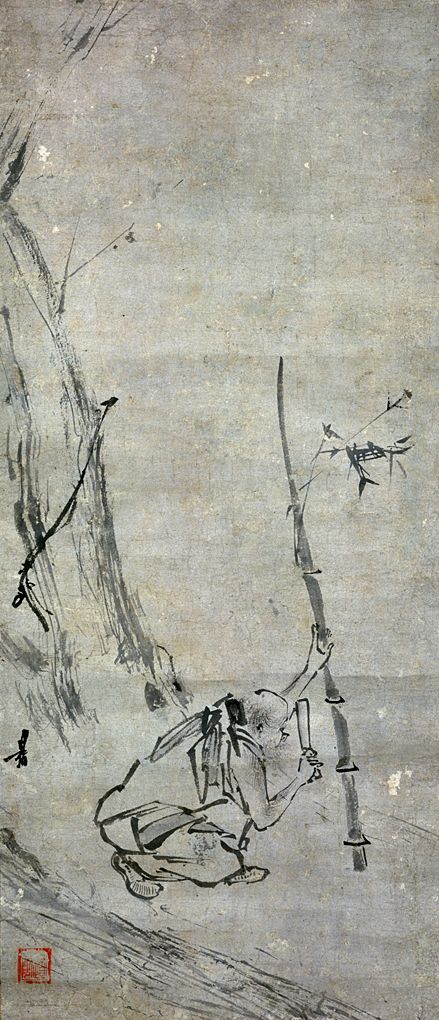
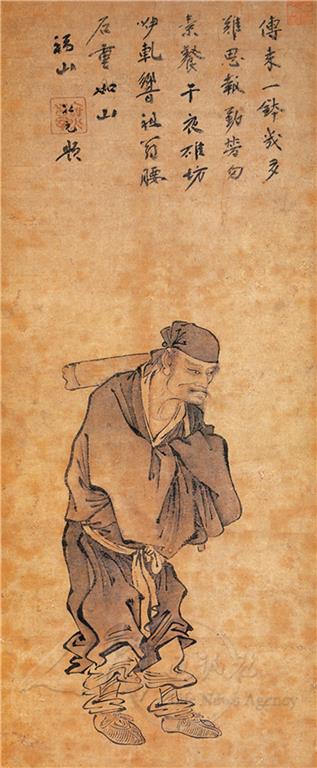
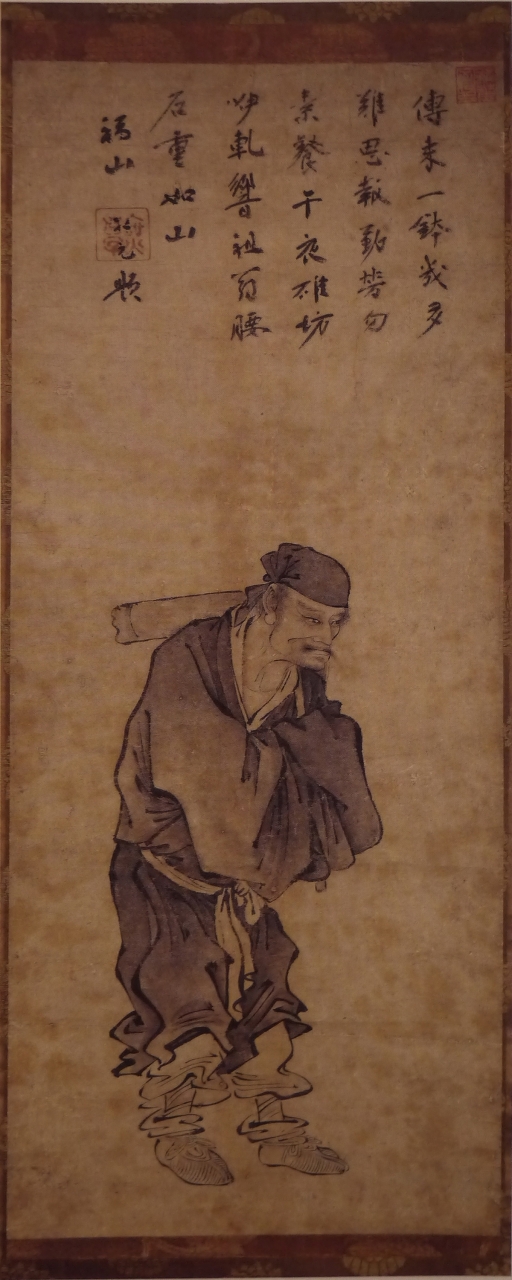
六祖斫竹圖 Liang Kai's figure painting inherits from the style of fine ink lines by Li Gonglin (李公麟, 1049–1106), a literary artist in the end of the Northern Song dynasty, but with considerable variation. Its main characteristic is its simple and hurried expression in ink. The sixth patriarch cutting the bamboo is, together with Li Bai in Stroll, one of the masterpieces of figure paintings by Liang Kai. |
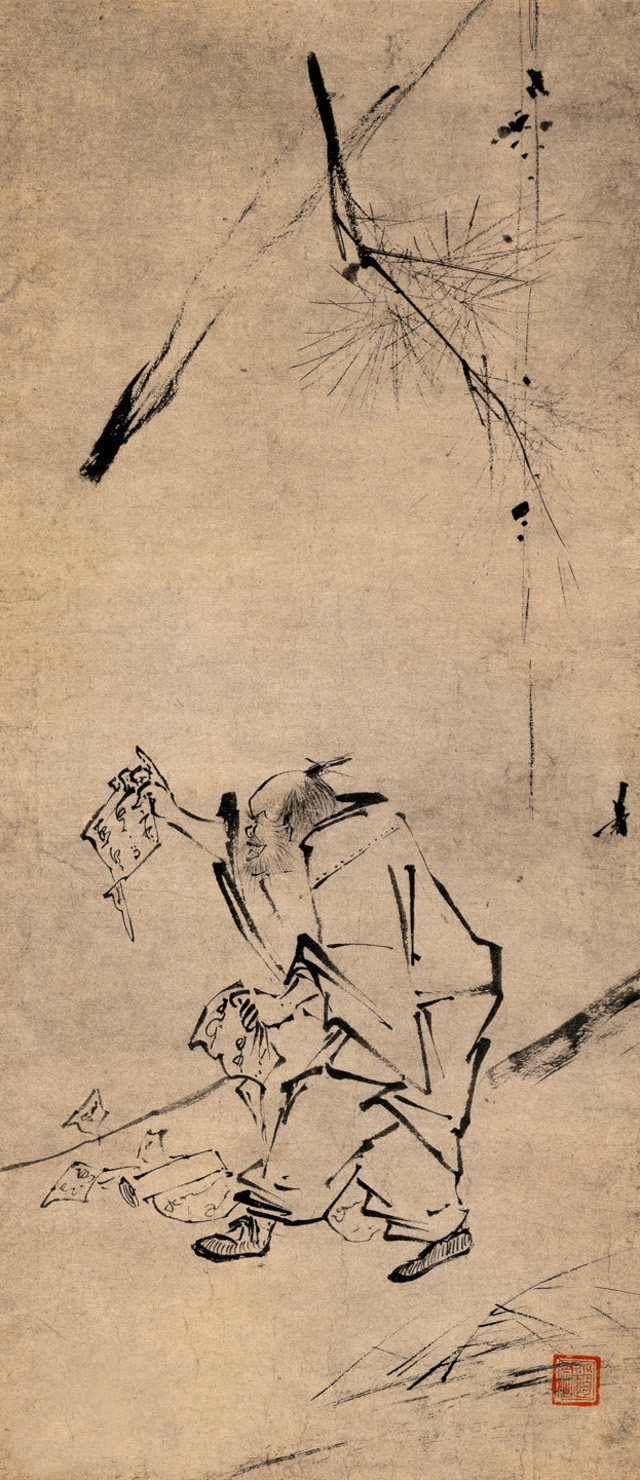 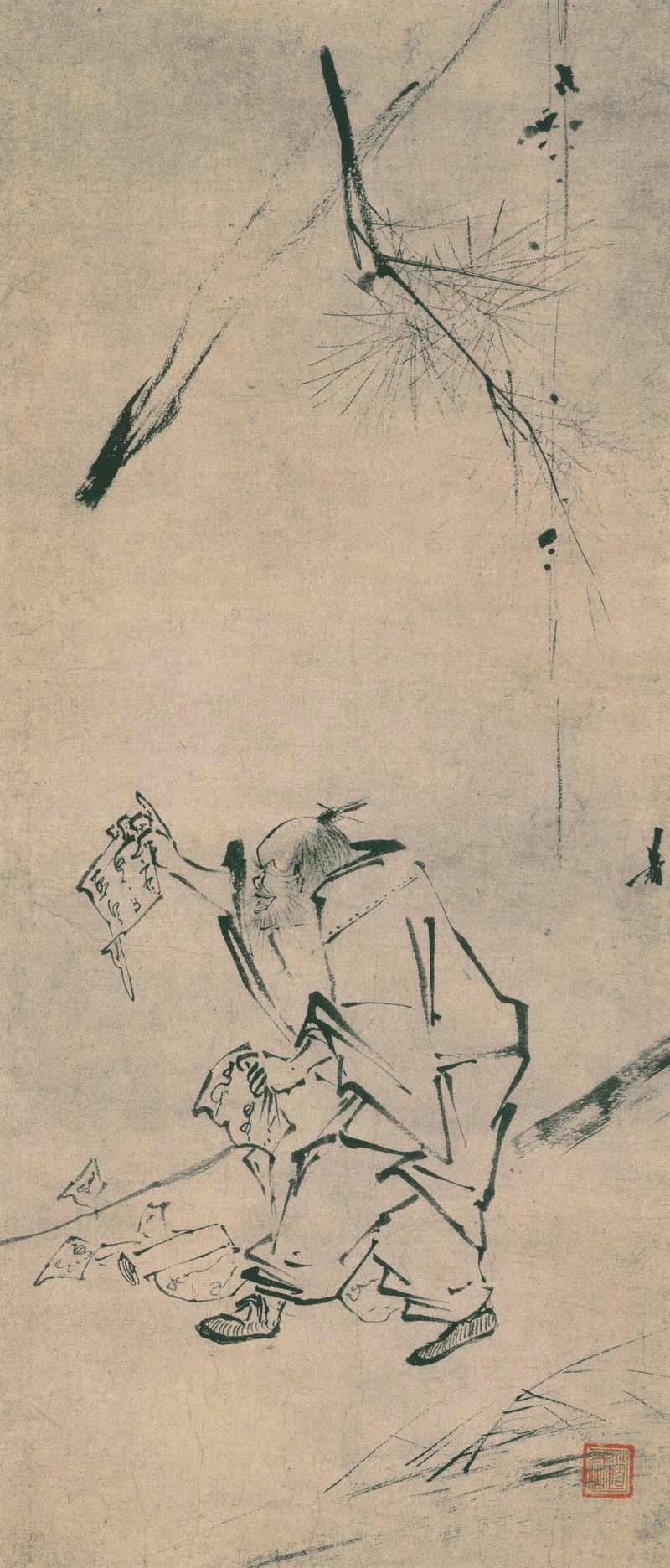 |
六祖破經圖
|
|
|
|
|
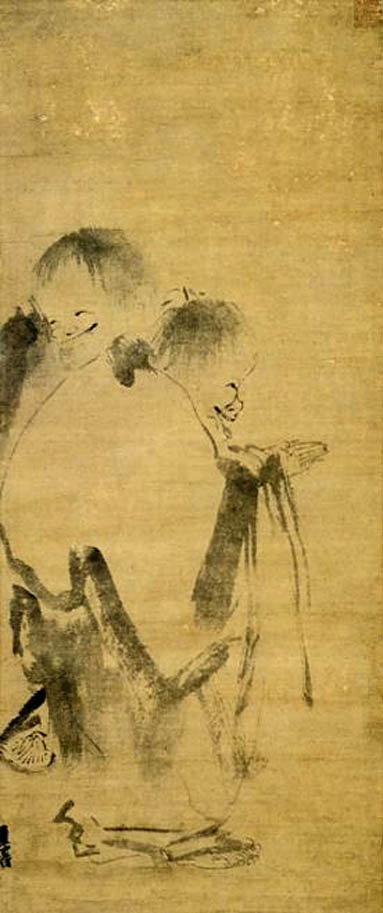
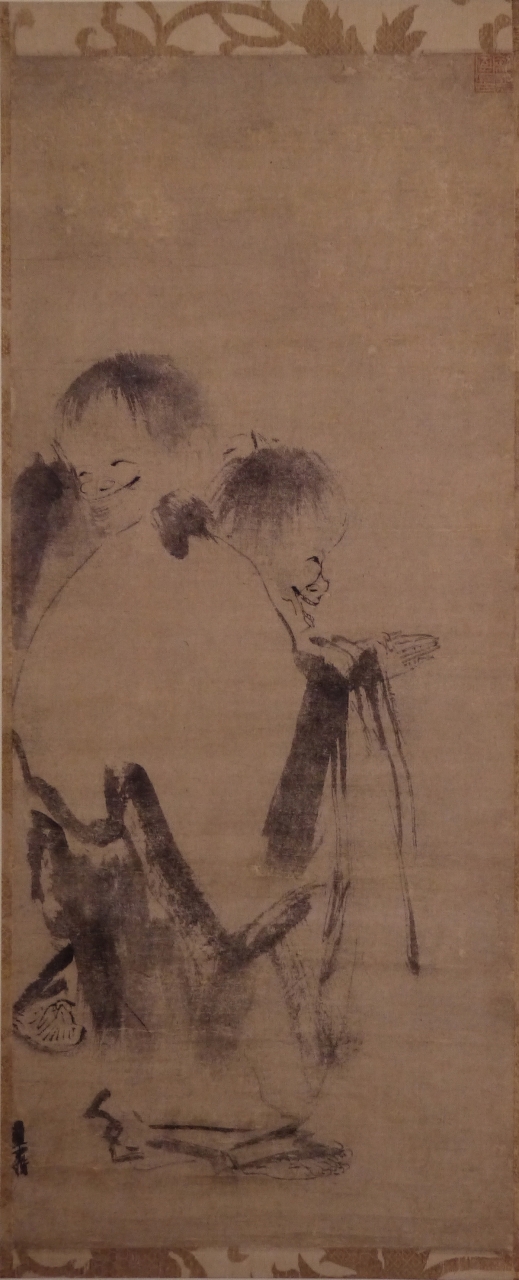
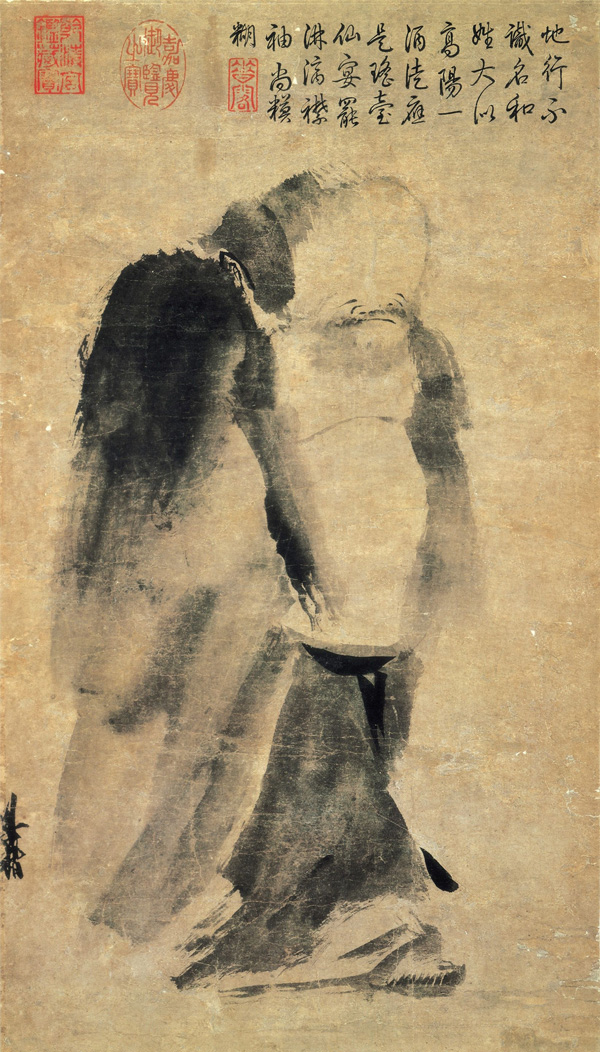
潑墨仙人圖 Pomo xianren tu When he was at court, his paintings were admired for their refined brushwork. This album leaf, however, is said to be a masterpiece from his period of drinking and spontaneous painting. The immortal shown here also appears to be somewhat inebriated. As a being of elevated status, his proportions also differ from those of ordinary mortals. The protruding forehead and rounded belly are accented by a few shods of hair and surrounded by unkempt robes that hang loosely down. No lines were used for these parts of the painting as only a few short slanted strokes were employed to define some of the details. Brushwork, however, defines the belt. The painting was first sketchily rendered in light washes of ink, and then darker ink was applied before the washes had dried in order to convey the weight of the immortal's body. The remaining elements, such as the humorous facial features, were dotted to give the final touch to the immortal's mysterious qualities. Despite the brevity of the work, nothing seems to be missing. This type of brushwork, in which the number of brushstrokes is reduced, is often referred to as "abbreviated brush" and used in Buddhist and Taoist figure painting to convey the untrammeled and supernatural qualities of the supernatural beings. It is said that when Liang K'ai sobered up, he looked upon this painting with a sense of pride. This is the second leaf from the album "Ming-hua lin-lang."
梁楷所畫的 「仙人圖」
|
  |
Han-san
és Si-tö
|
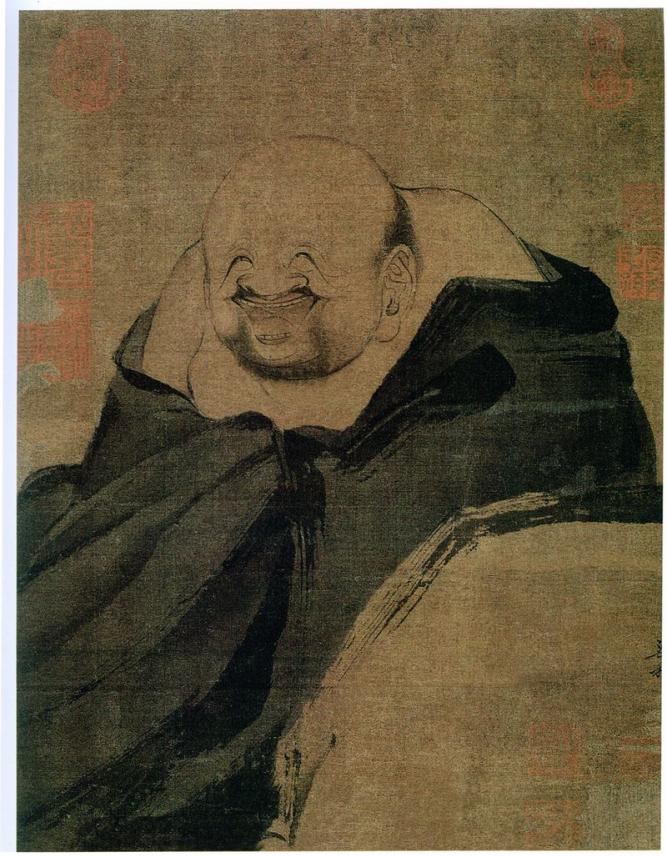 |
布袋和尚 |
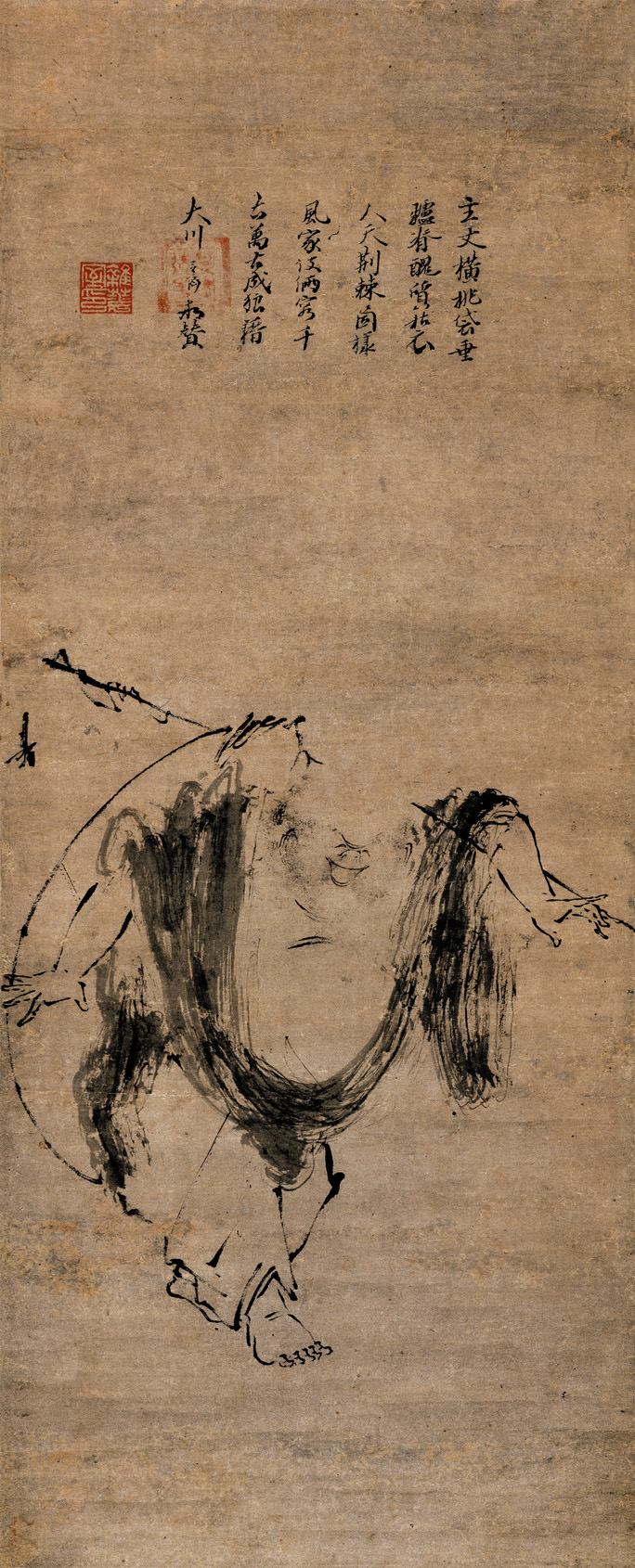 |
Pu-taj batyuval a hátán táncra perdül Budai 布袋圖
„Fenghua
Hszienben, Mingcsouban élt Pu-taj, akit Rongyos Zsák mesternek hívtak, mert olyanra
hízott, mint egy jól kitömött batyu. A homloka szűk volt, a pocakja kövér, a beszéde
szokatlan. Ott hevert le mindig, ahol rájött az alhatnék. Gyakran szundikált a
hóban, csak úgy ültében, felhúzott térdekkel, de nem esett baja. A vállán átvetett
boton lógott a batyuja, mindenét abban hordta magával. A vásártéren válogatás
nélkül összekoldult bármit, amit csak meglátott, hogy megegye vagy eladja. Jövendőmondásban
sosem tévedett. Eső előtt vízbe áztatott szalmabocskort viselt, száraz időben
magaslábú sársarut. A környékbeli emberek figyelték a jövését-menését, és ebből
tudták, milyen idő várható. 917-ben halt meg összefont lábakkal a Jüe-lin templom
keleti tornácán ülve. Ám halála után is gyakran látták kószálni batyuval a hátán,
és a szerzetesek versengtek egymással, melyikük tudja élethűbben megfesteni Pu-taj
alakját.” |
  |
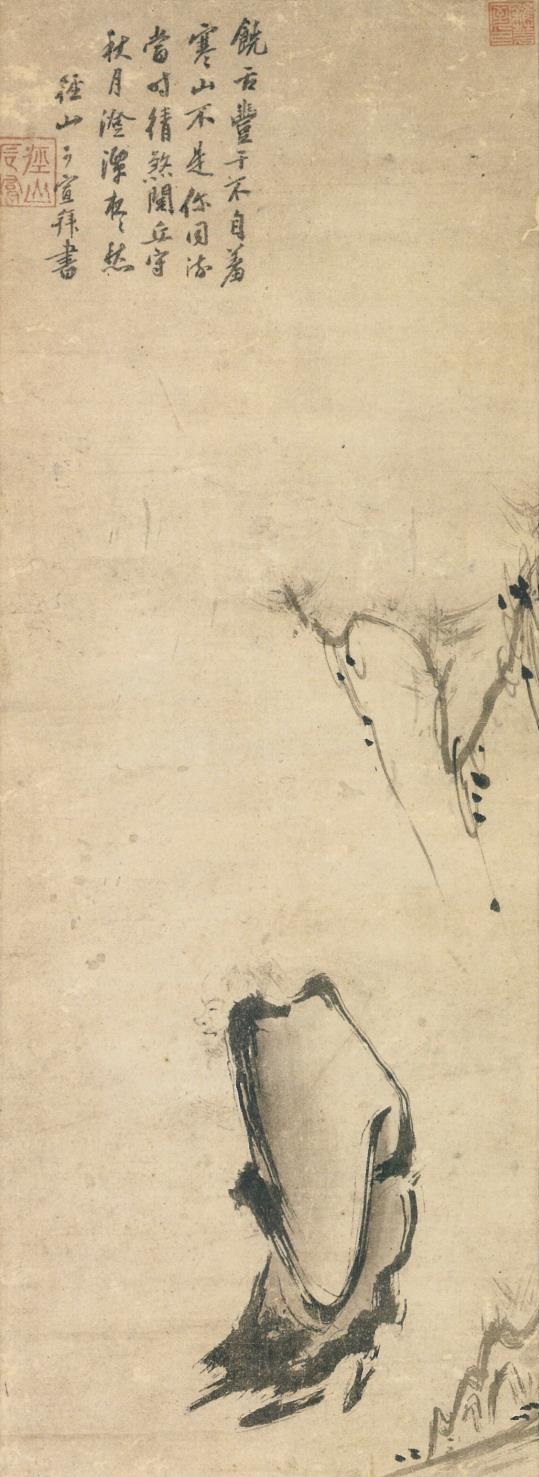
「鶏骨図」
|
 |
|
|
|
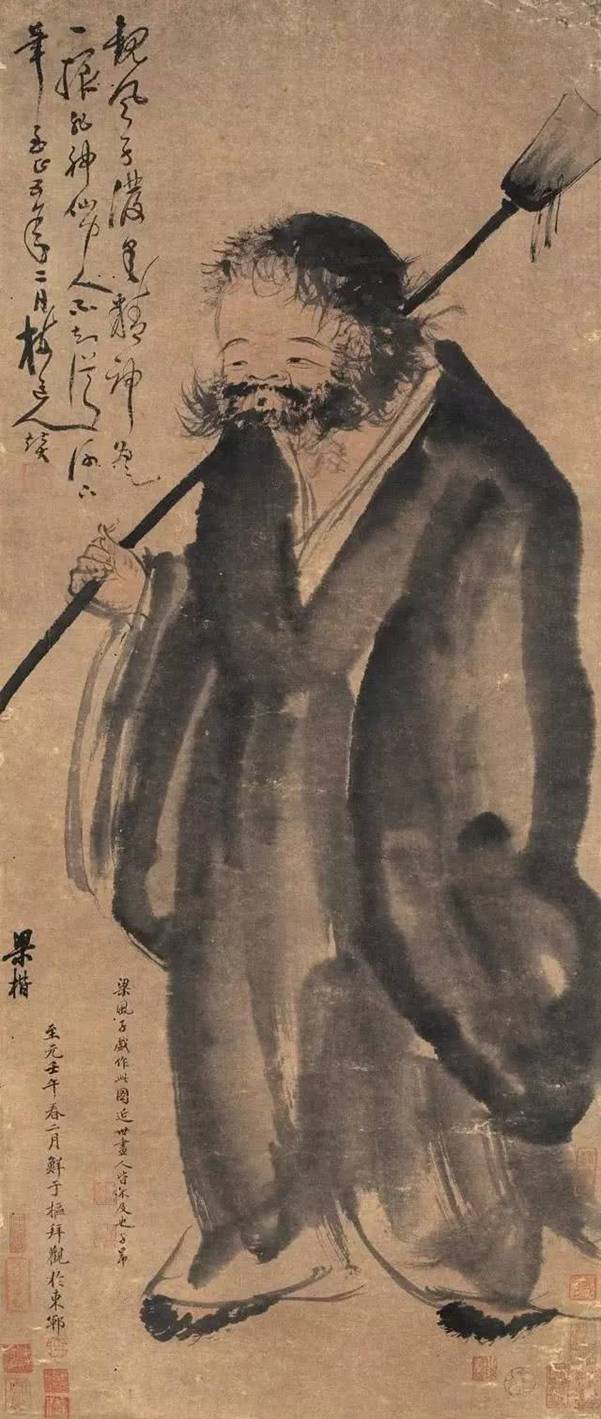
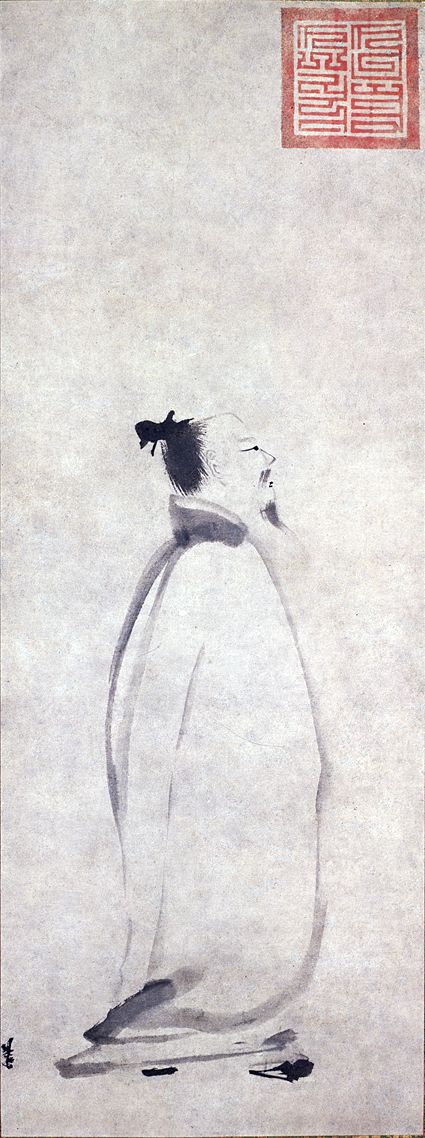
李白行吟圖 This picture shows the genius poet Li Bai (李白, 701-762) in all his splendor using simple strokes of ink. The owner's seal applied to the painting means "seal of great ancient official" in Paspa script and is said to be the seal of Anigo who served the Yuan dynasty. From a copy owned by the Kanô clan, it is known to have formed a pair with a picture by Dongfang Shuo (東方朔, ca.161-93 BC) in the Edo period (1603-1868). The fact that it used to be owned by Matsudaira Fumai, shows its noble origins.
|
|
| Sákjamuni
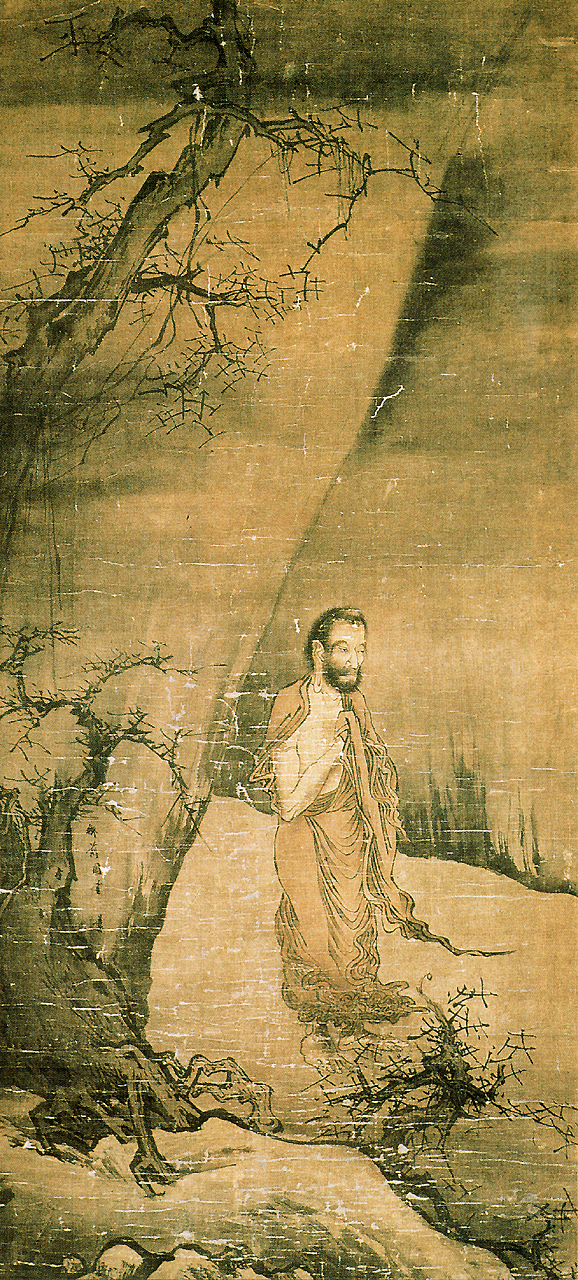
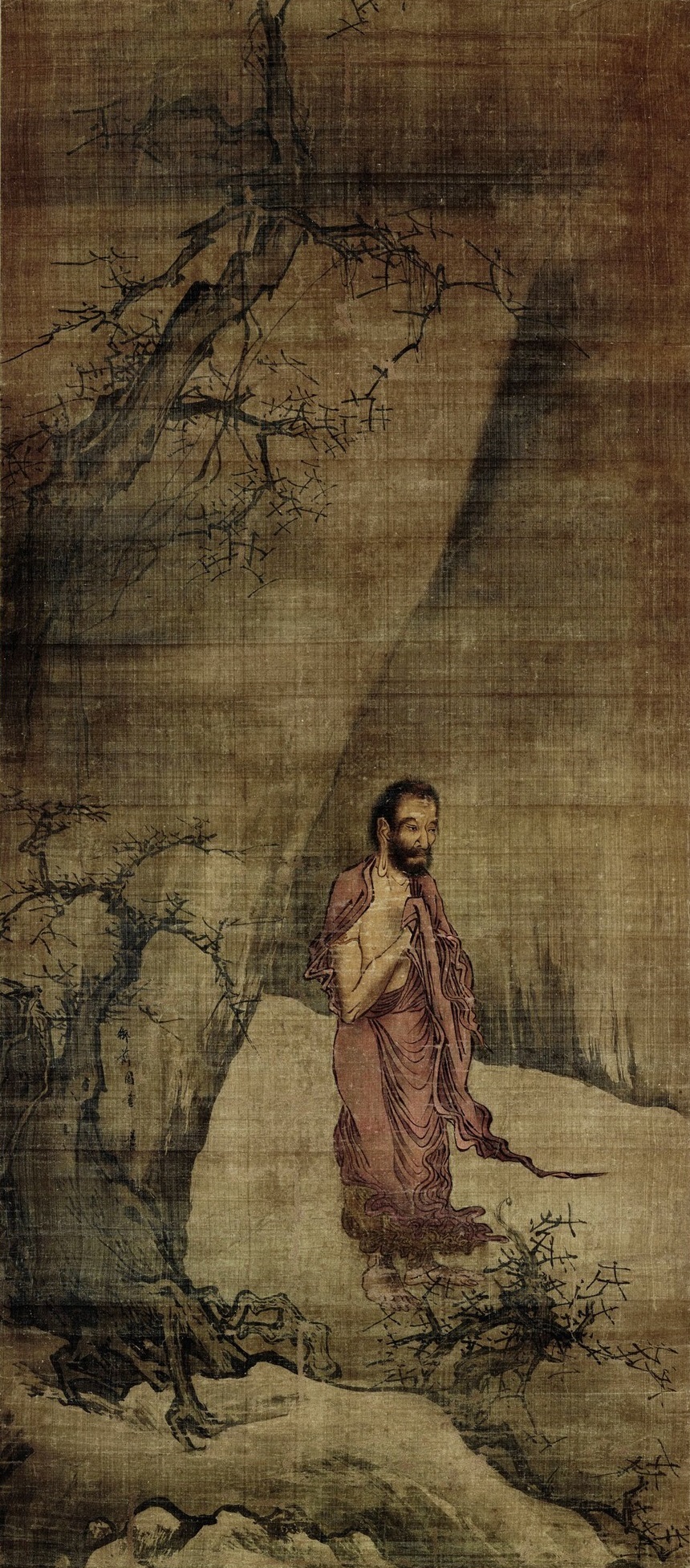
lejön a hegyről Signature from lower left: Liang Kai was also good at detailed and solemn figure painting with colors. This picture depicts an image of Sakyamuni who failed to attain wisdom, in spite of a long period of ascetic practices, descending from his abode on the mountain. Its precise and realistic expression of the figure is extremely superb. Its seal, "Liang Kai, painted before his excellency," indicates that it was painted in the Imperial Palace, and it is a masterpiece of Liang Kai's color figure painting. |
|
|
東籬高士圖 Gentleman of the Eastern Fence Dongli Gaoshi 71.5 x 36.7 cm National Palace Museum, Taipei |
|
|
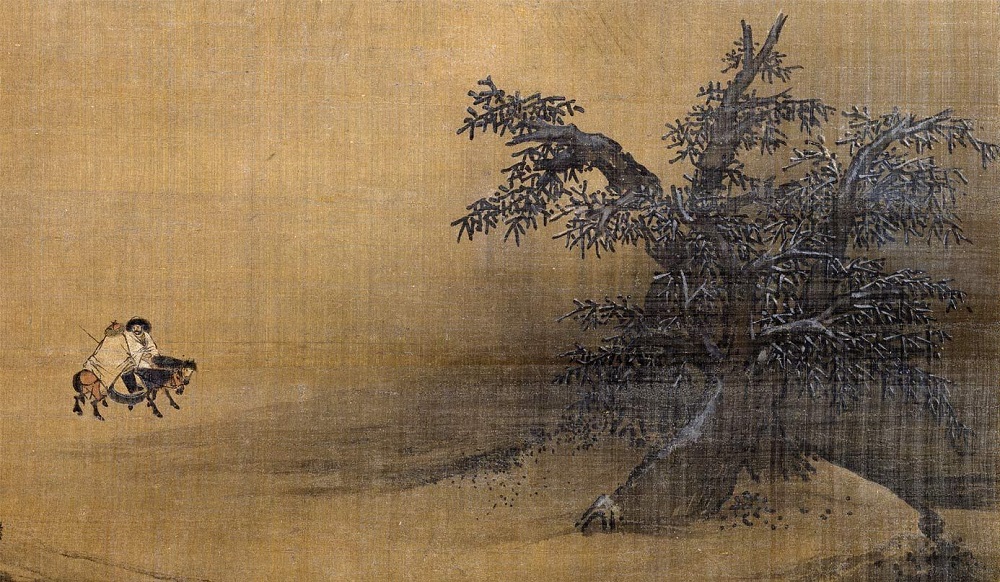
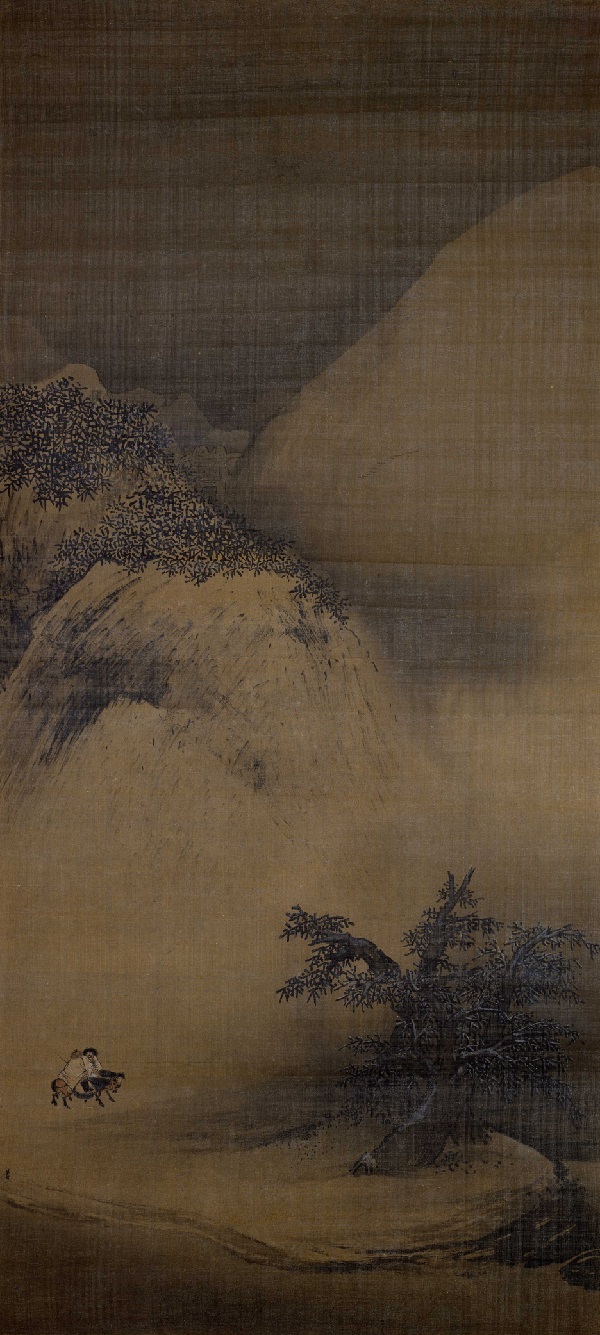
雪景山水圖 Havas táj Landscape in snow, two men on horseback approaching a pass 110.3 × 49.7 cm Tokyo National Museum |
|
|
羲之書扇圖 Liang
K'ai served as a Painter-in-Attendance in the Chia-t'ai era (1201-1204) at the
court of Emperor Ning-tsung. Liang K'ai specialized in figure painting. Due to
his reduction of the brushwork for a spirited effect, his style has been described
as "abbreviated brushwork". |
|
|
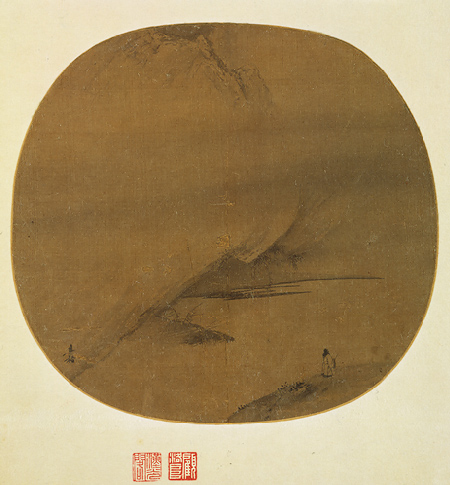
Zeyan xingyin tu 澤畔行吟圖 |
|
|
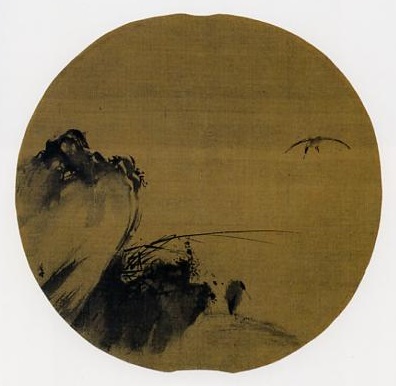
Kócsagok |
|
|
|
|
|
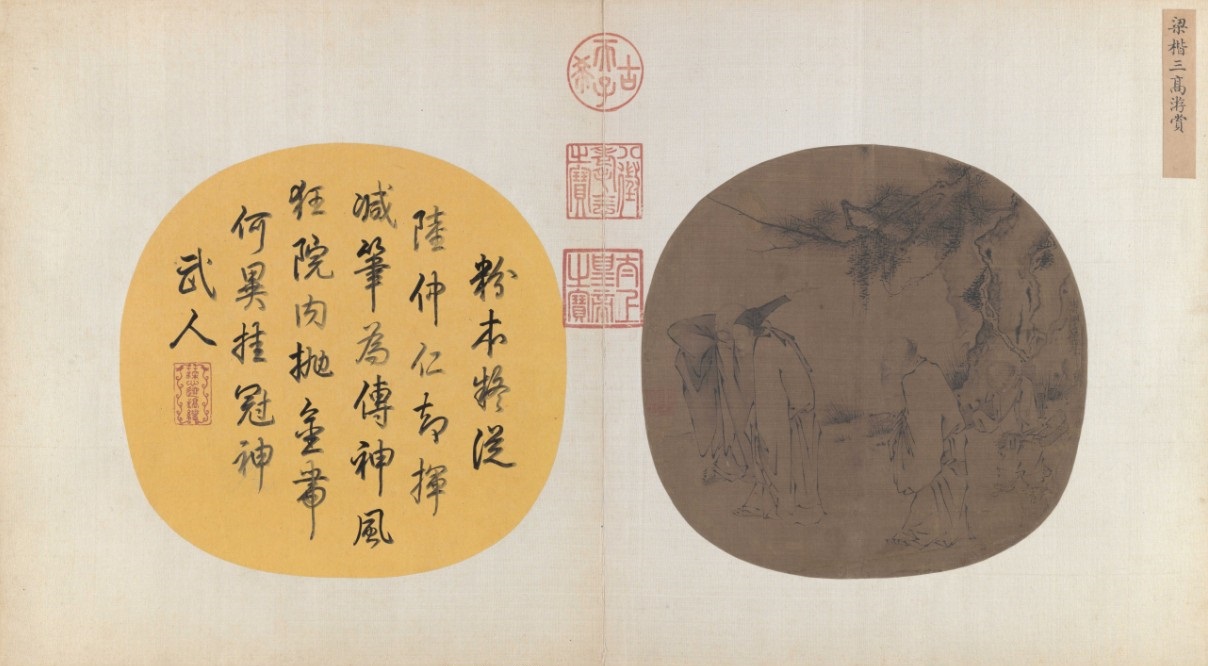
三高游赏图页 |
|
|
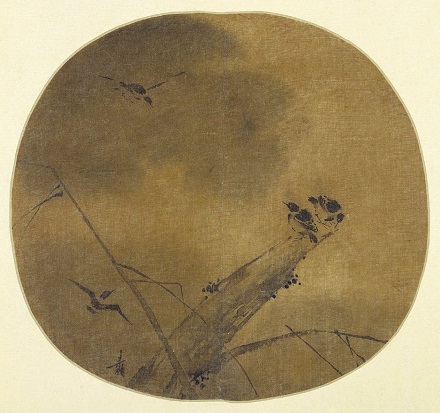
Két madár és őszi fűz On a rounded fine silk, the thin elastic twig of a weathered willow painted with charred ink slants the picture into two parts. The autumn wink blows off the delicate willow twigs to the right, separating a couple of cold crows, screaming and flying. Thin cloud in light ink is alternately indistinct or visible; the picture is structured like a Yin and Yang fish, a breakaway from convention. Only a free-spirited painter like Liang Kai could stand out from academy painters, who were obsessed with rigor and refinement. And only Liang Kai was capable of such outrageous structure, and such simple yet powerful works. |
|
|
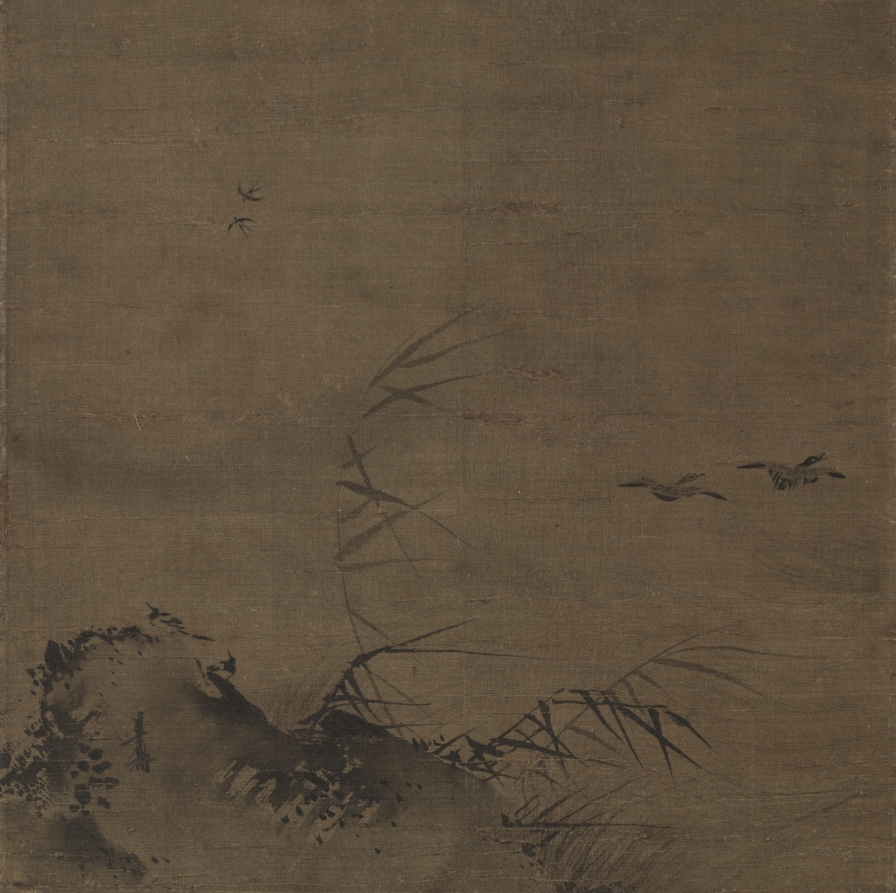
Vízimadarak és nádas |

亲 蚕 图 卷 克利夫 兰 美 术馆 藏
Selyemhernyó-tenyésztés és selyemszövés
Sericulture (The Process of Making Silk)
attributed to Liang Kai
handscroll, ink and color on silk,
Third Section - h:27.30 w:93.50 cm
Second Section - h:27.50 w:92.20 cm
First Section - h:26.50 w:92.20 cm
The Cleveland Museum of Art, John L. Severance Collection 1977.5
Nyolc jeles szerzetes
Eight Eminent Monks
高清大图【梁楷-八高僧图卷详解】上海博物馆藏--南宋 Bagaoseng gushi tu
The Shanghai Museum of Art
http://blog.sina.com.cn/s/blog_769fb5f30101atj8.html
(1) Seng Guangshen xiang Damo qing jiao de gu shi--
(2) Wu zu Hongren da shi you shi yu jian "Zhi zhe" de gu shi--
(3) Bai Juyi dao Qiantang jin jian Wuke Daolin chan shi de gu shi--
(4) Xiangqing Zhixian chan shi yin sao di er jue wu de gu shi--
(5) Li Yuan he Yuanze fa shi zai chuan shang yu jian yi nü zi ji shui de gu shi--
(6) Guanxi Xian chan shi zai lu shang yu jian yi tong zi ji shui de gu shi--
(7) Louzi he shang zai jiu lou qian wen ge sheng hou gui bai de gu shi--
(8) Xuansha Bei chan shi diao yu de gu shi.
English translation in PDF: pp. 437-445.
Narrative agency in thirteenth-fourteenth century Chan figure painting : a study of hagiography-iconography text-image relationships
by McNeill, Malcolm L. S.
Thesis (Ph.D.), SOAS University of London, 2017.
https://eprints.soas.ac.uk/24335/1/McNeill_4375.pdf
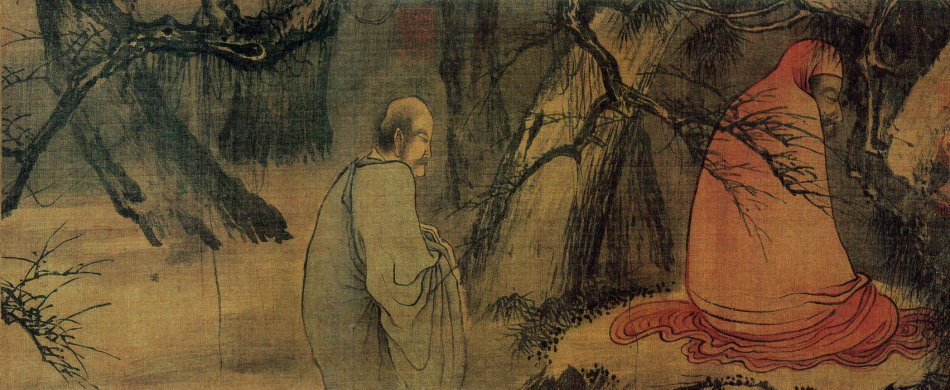
图一《达摩面壁 · 神光参 问》 绢本设色 尺寸: 26.6 × 64.1 cm
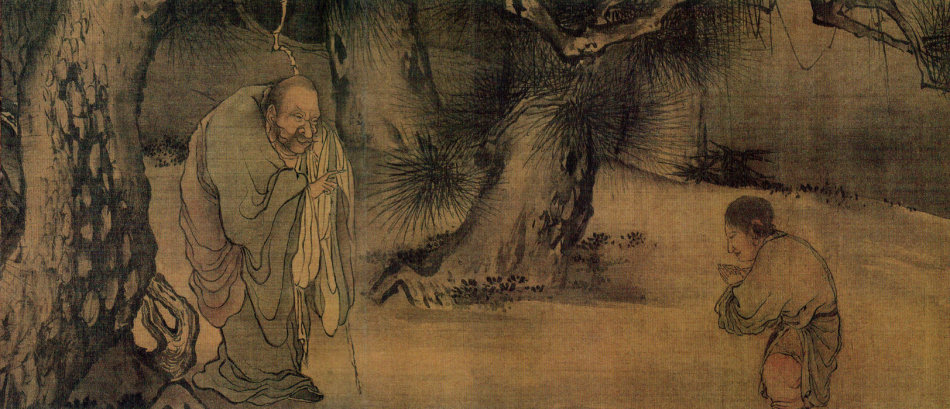
图二《弘忍童身 · 道逢杖叟》 绢本设色 尺寸: 26.6 × 66.4 cm
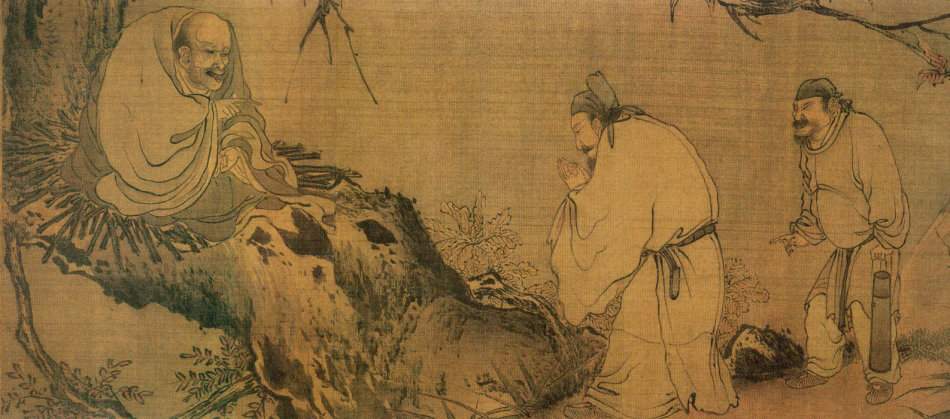
图三《白居易拱谒 · 鸟窠指说》 绢本设色 尺寸: 26.6 × 64.7 cm; Section 3: Niaoke (“Bird's Nest”) and Bai Zhuyi
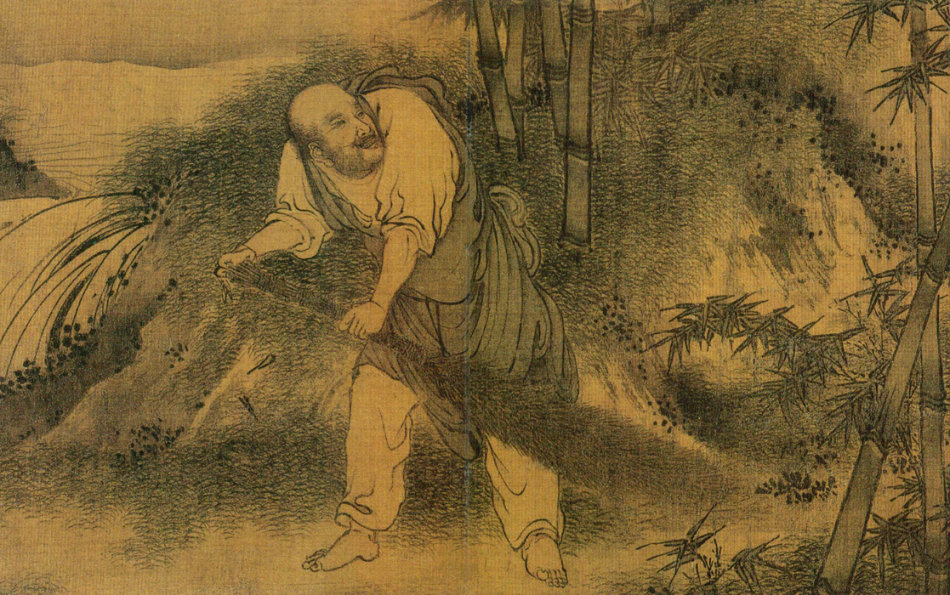
图四《智闲拥帚 · 回睨竹林》 绢本设色 尺寸: 26.6 × 64.7 cm
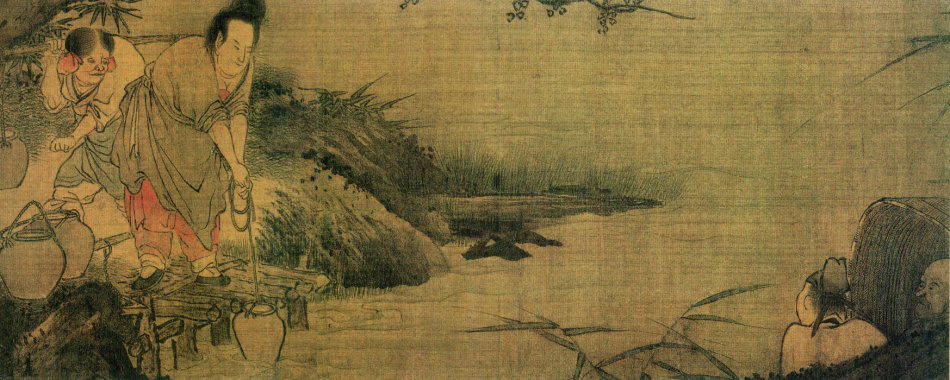
图五《李源圆泽系舟 · 女子行汲》 绢本设色 尺寸: 26.6 × 67.1 cm
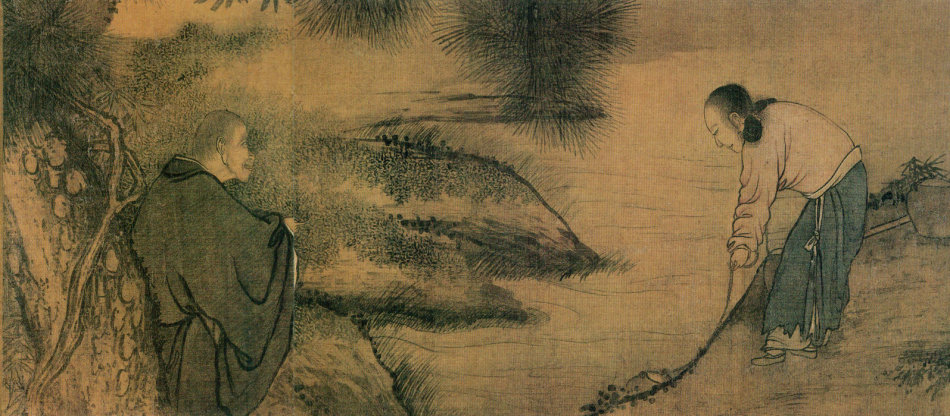
图六《灌溪索饮 · 童子方汲》 绢本设色 尺寸: 26.6 × 61.9 cm
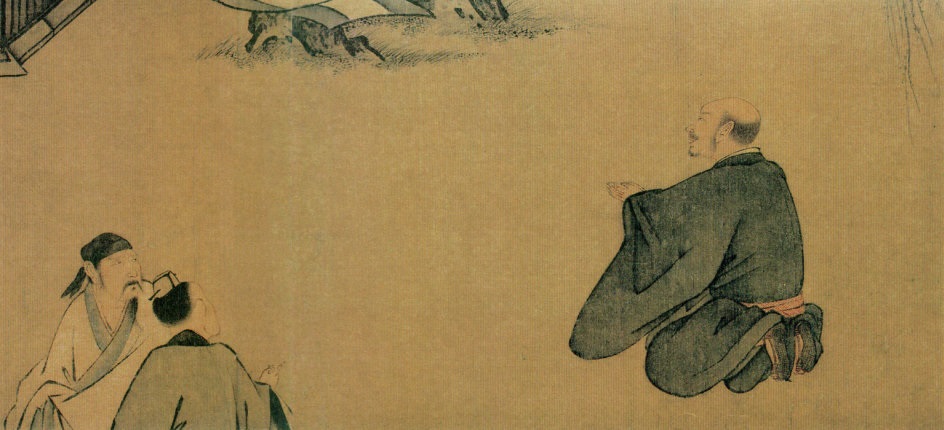
图七《酒楼一角 · 楼子参拜》 绢本设色 尺寸: 26.6 × 57.9 cm
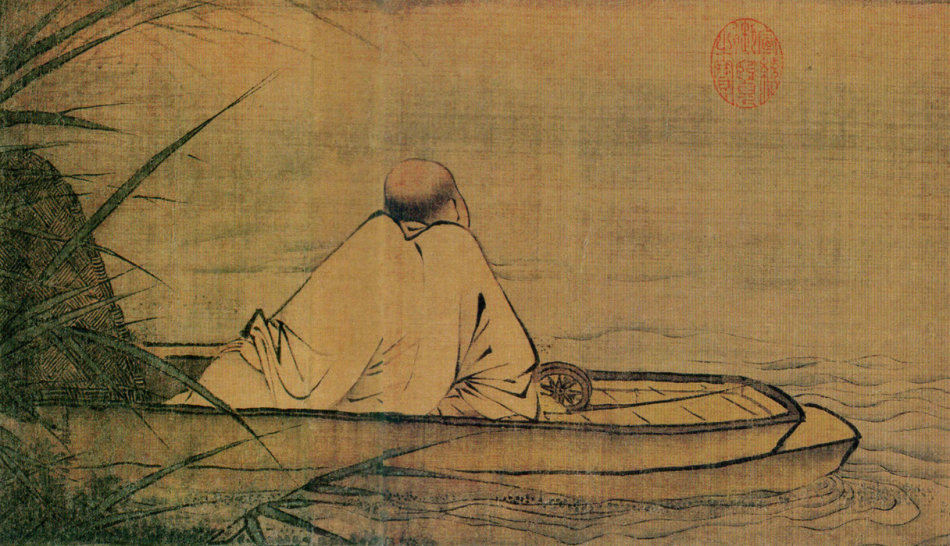
图八《孤蓬芦岸 · 僧倚 钓车》 绢本设色 尺寸: 26.6 × 66.2 cm
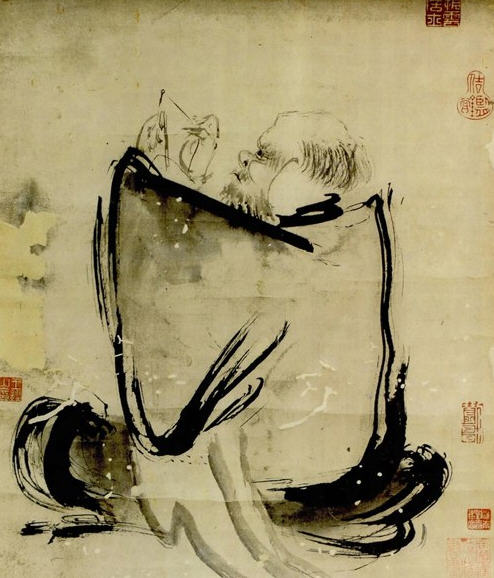
补衲图 Patching the Robe by 梁楷 Liang Kai (1140-1210)
民间收藏的《补衲图》应当是大陆仅见的以“折芦描”方法创作的梁楷写意画。
http://www.foyuan.net/article-235541-1.html
http://www.wenbo.cc/html/wbxx/1011171448187E34J.asp
 |
Han-san és Si-tö |
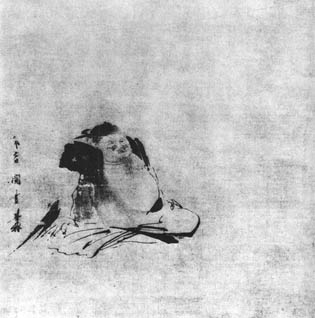 |
Részeg szerzetes |
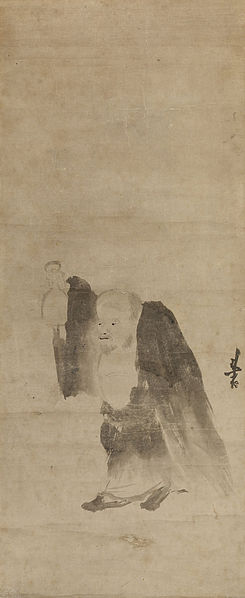 |
|
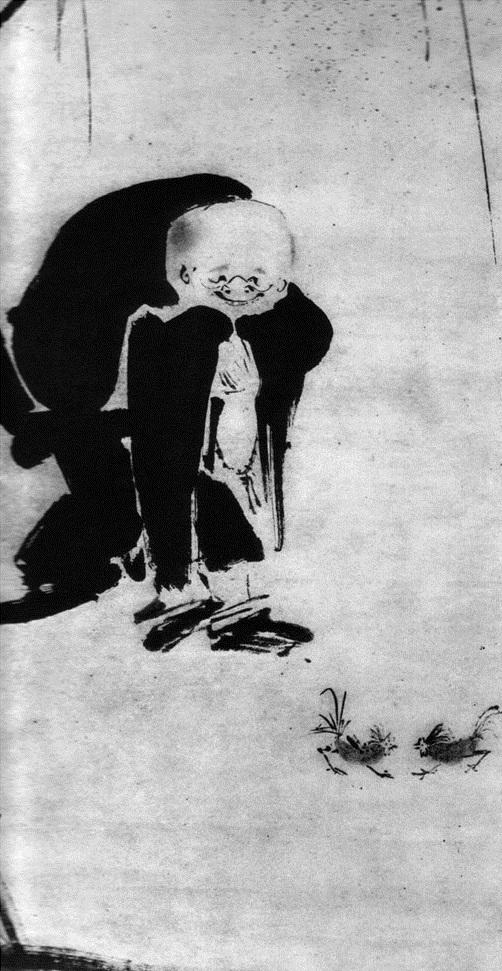
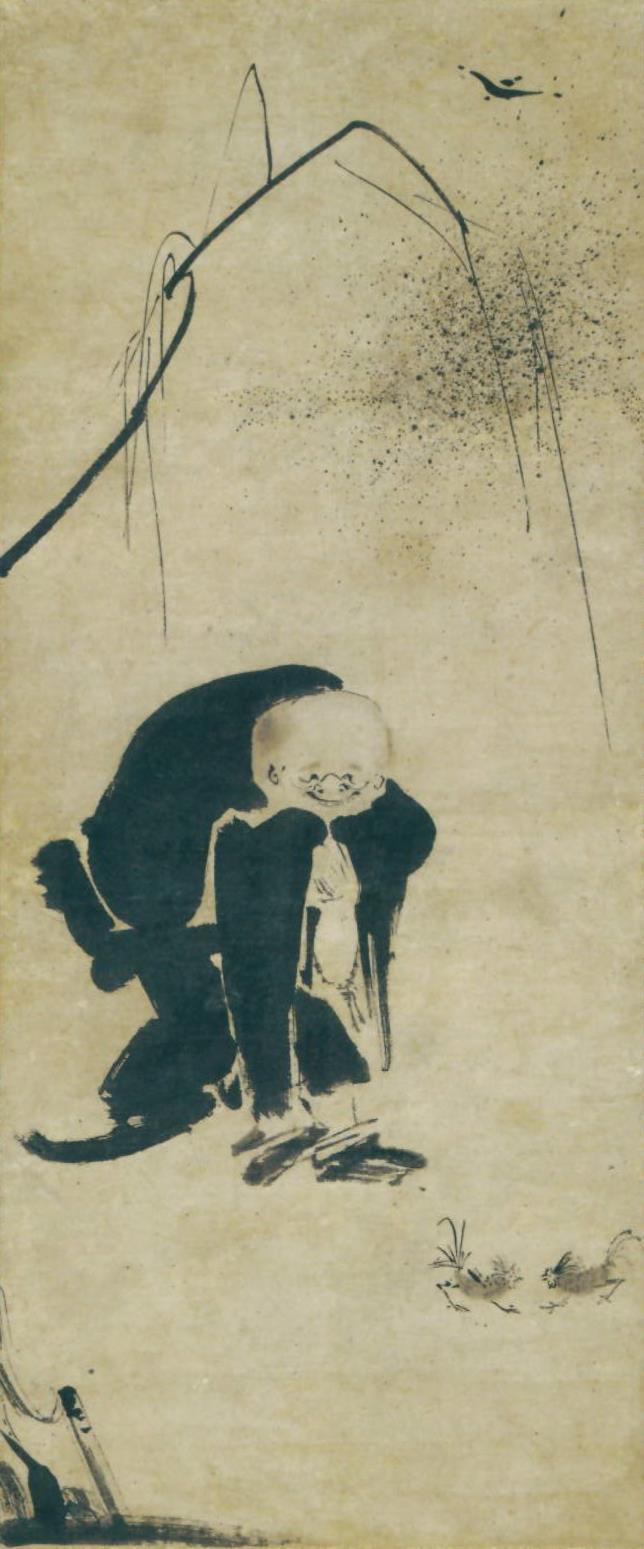
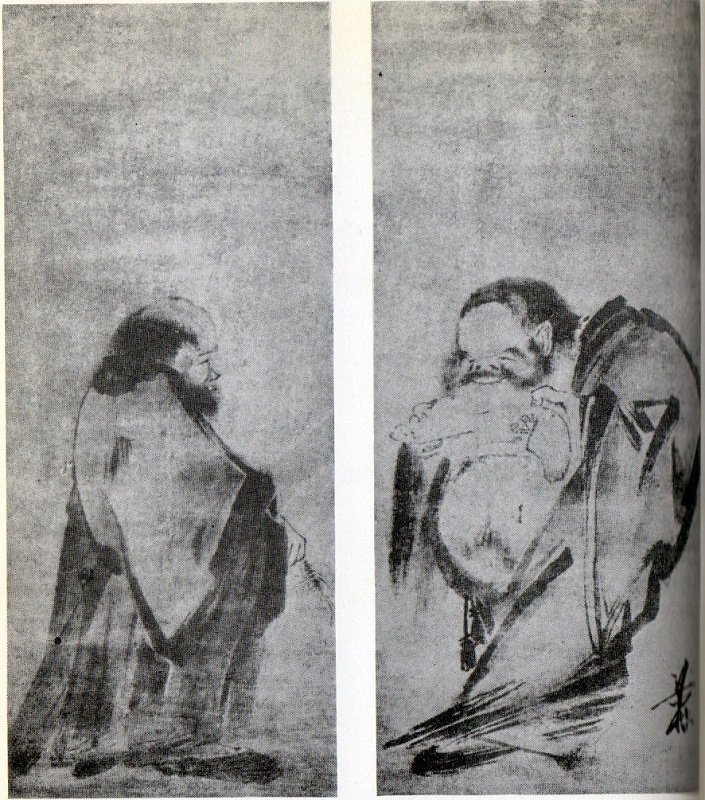
Hsien-tzu ("Clam"; Japanese: Kensu) and Chu-t'ou ("Pig's Head"; Japanese: Choto) are two typical Ch'an characters. Although they were originally in no way related or associated, they are often depicted on scrolls that form a pair. Their association is probably due to the non-vegetarian habits that they share, which set them apart from the regular Buddhist clergy to whom such habits were anathema.
When he went to Master Tao of Wen-shu, who was to become his teacher, the Master asked him: "What did you see when you were about to slaughter that pig? What made you shave your head and depart on a pilgrimage?" Ssu-yeh thereupon made a gesture as if he were whetting his knife. --from Zen Painting and Calligraphy by J. Fontein and M.L. Hickman |
|
List of the paintings attributed to the painter Liang K'ai
Of 27 paintings listed for Liang K'ai, one is a horizontal scroll, two are fan-shaped and the rest are vertical hanging scrolls. Only two have inscriptions that can be seen in the reproductions, which have been cropped to fit our book sizes. The cropping makes it hard, however, to judge the original size. The right sense of placement or whole composition is lost, besides the seals and the inscriptions.
Each entry including the name of the painting first. The owner, miscellaneous detail, best source of reproduction, and Osvald Siren's authenticity grades follow. Siren's grading is: A, A?, B, B?, C, C?, in descending order of possible authenticity. The books available for reproductions in this paper are fully listed (numbers 9 {Chung-kuo ming-hua chi}, 43 {Time}, 60, 61 {Siren}, and 75 {Waley}), with the other possible sources, in the Bibliography. To that I might here add that No. 60 occupies itself with numbers, No. 61 with plates. {Note: for a few listings, the online version adds a category: Internet.}
Sakyamuni leaving his mountain retreat. Count Sakai. Signed. Siren #325. A. Internet: National Museum of Tokyo, Sakyamuni descending the mountain after asceticism. Dark with faint color. http://www.tnm.jp/scripts/col/MOD1.en.idc?X=TA617
Three old trees by a slope in snow. Institute of Art Research, Tokyo. Ink and slight color on paper. Siren #333/ A?
Landscape in snow, two men on horseback approaching a pass. National Museum, Tokyo. Signed. Siren #332. A
Winter birds. M. Chas. Vignier, Paris. Not on Siren list. Waley.
A pair of herons alighting on rocks. Hakone Museum. Signed fan-painting. Siren plate 75. B
Winter landscape with a dry tree and birds. Fogg Art Museum, Cambridge, Mass. Fan-shaped, signed. B?
Wild geese and some reeds on the shore. Prince Yoshihisa Toku-gawa ("Hereditary Shogun of Japan"). Album leaf, signed. Toso Gemmin Meiga Taikan {73}, p. 82. B
Top of a bare willow-tree, two birds in flight. Ink and slight color on silk. Signed, Album leaf. Hui-hua Kuan. B
Sixteen arhats or lo-han. M. Abe. Long handscroll, signed and sealed. Colophons by Wang Wen-chin, p. 89. Possibly a Ming picture. B?
Wang Hsi-chih writing on a fan. Manchu household Collection, Peiping. Several colophons of the Yuan period, one dated 1323. Poem by Chien-lung. Siren #327. A. Internet: National Palace Museum (China). http://www.npm.gov.tw/english/exhbition/ecol0401/sel-02.htm
Hui-neng chopping bamboo. National Museum, Tokyo. On paper. Siren #328. Internet: The sixth patriarch cutting bamboo. A. Internet: National Museum of Tokyo. http://www.tnm.jp/scripts/col/MOD1.en.idc?X=TA143
Hui-neng tearing up a sutra. Count Matsudaira. Early Japanese copy after Liang Kai. Siren #329.
Pu-tai carrying a sack. Murayama Collection. Signed. Kokka, No. 152. A?
Li T'ai-po. National Museum, Tokyo. Ink on paper, 79 cm. by 30 cm. Signed. Siren #330. Internet: National Museum of Tokyo. Li Bo in stroll, http://www.tnm.jp/scripts/col/MOD1.en.idc?X=TA164
An old Immortal in a loose open gown. Signed. Inscription by Chien-lung. Imperial Collection (formerly in Peking), Formosa. Time Magazine, May 6, 1957. B? Internet: Immortal in Splashed Ink. Album leaf, ink on paper, 48.7 x 27.7 cm. National Palace Museum (China). http://www.npm.gov.tw/english/collections/p022.htm
Two hermits. Asano. Kokka, No. 402. B
Monk eating a pig's head; Monk holding a shrimp. Masuda. Kokka No. 114. C http://www.coldbacon.com/kensu.html
Han-shan and Shih-te. Hakone Museum. Toyo Bijutsu Taikan IX, plate 65; Matsudaira. Signed. Kokka, No. 40. B?
An old drunkard. Count Matsudaira. Album leaf, signed. Kokka No. 145. B?
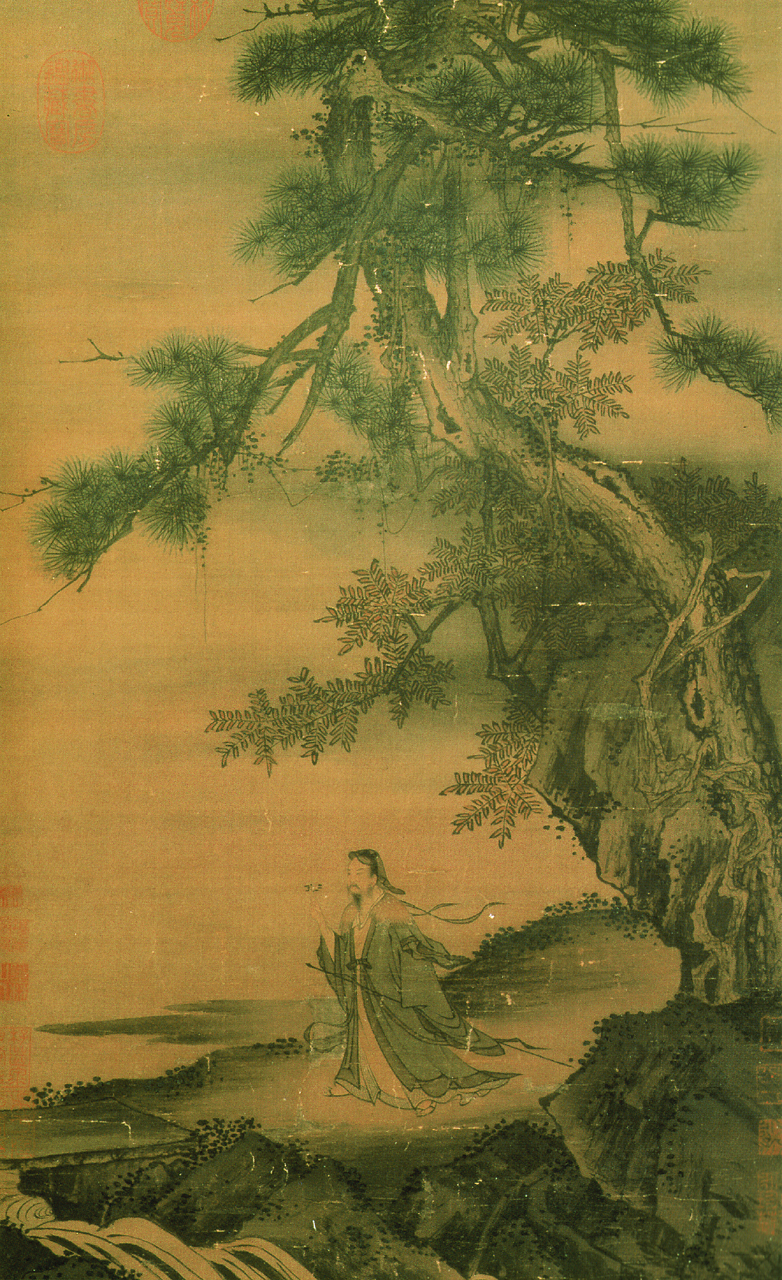
A man standing between two old pines looking at a waterfall. Attributed by Wang Tsuan, Yuan period. C
A man sleeping under a pine tree. P'ang Yuan-chi Collection, Ink on silk, album leaf. Hui-hua Kuan. A?
Three old scholars under a pine tree. Ink on silk, album leaf, signed. Hui-hua Kuan. B?
A fisherman with his nets returning home in snow. M. Hayasaki. Signed fan-painting. B
A man reading and a grazing buffalo by a tree. Formerly possession of the Marquis Kuroda. Handscroll, signed. Toyo Bijutsu Taikan IX, plate 72; 9. C
A man seated on a projecting cliff under a pine tree. M. Magoshi Collection, Signed. Toyo Bijutsu Taikan IX, Plate 69. B
Seated arhat. Nezu. London Exhibition Catalogue 972. Attributed. C
Figures. Owned by ? Album leaf. Pan Yuan-chi. Catalogue No. III. Attributed.
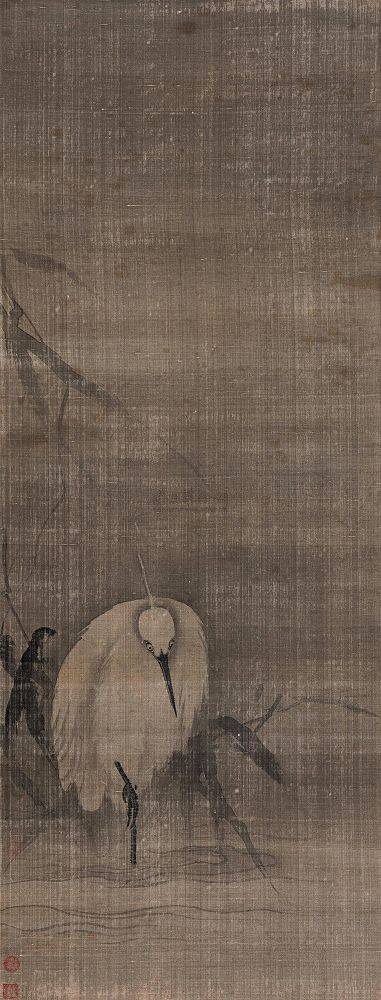
梁楷 (传) 白鹭立轴
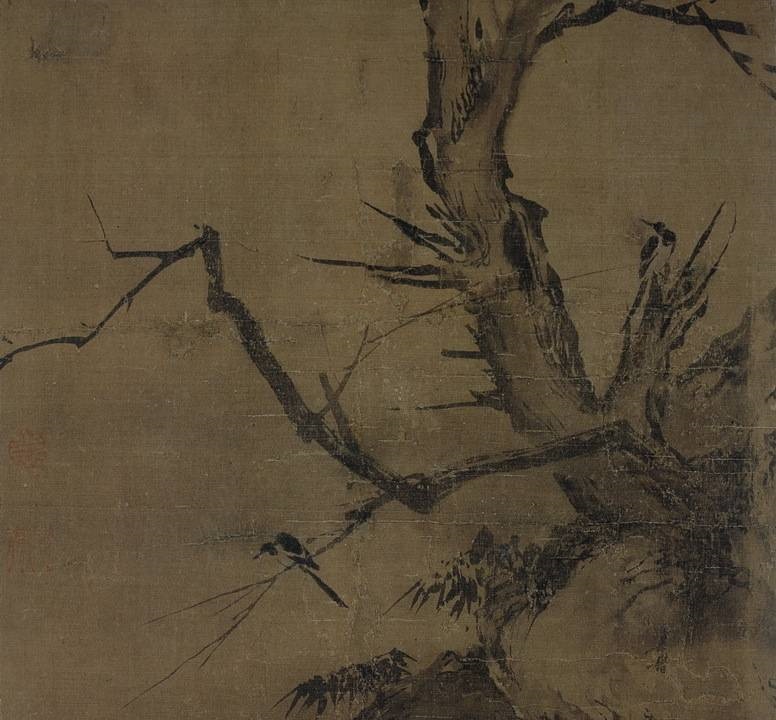
疏柳寒鴉圖
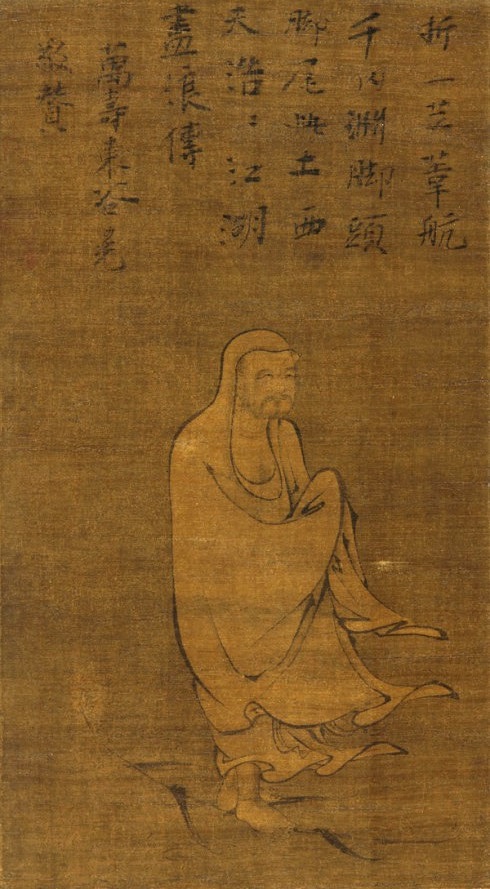
Bodhidharma Crossing the Yangzi on a Reed 蘆葉達摩圖
Traditionally attributed to Liang Kai 梁楷 (late 12th - early 13th century)
Before 1253, Southern Song, (1127-1279)
Encomium by Donggu Miaoguang 東谷妙光 (?–1253)
Hanging scroll mounted on panel, ink on silk, 46.7 x 26.0 cm
Freer Gallery of Art, F1907.141
Encomium:
He plucked a single reed stalk,
To sail the thousand - fathom deep,
Foot on prow and foot on stern,
This land, to the West ern Heaven:
Far and wide o'er river and lake, all a tale on the waves.Encomium respectfully [written] by Donggu Miaoguang of Wanshou [Temple, Suzhou].
折一莖葦, 航千仞淵, 腳頭腳尾, 此土西天, 浩浩江湖盡浪傳。 萬壽東谷妙光敬贊。


.jpg)